Execution Bridge, Stone tram bridge in Ghent, Belgium
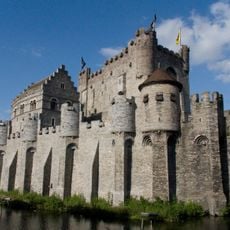
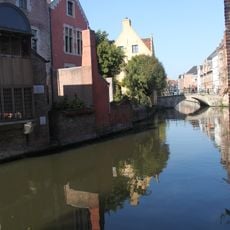
Execution Bridge is a low stone bridge beside Gravensteen Castle in Ghent, crossing a branch of the Leie that serves as the castle moat. Its flat deck carries a dark metal railing along the span, and a square sign with a black figure on a white ground, bordered in red, is mounted on the railing above the water. The bridge rests on brick and stone embankments.
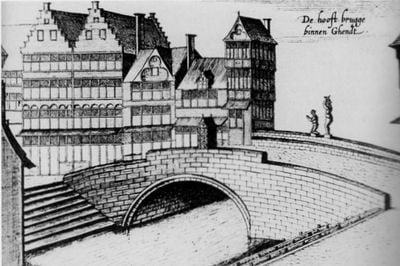
From 1371 or earlier, murderers and rapists were beheaded on this medieval stone bridge beside Gravensteen Castle, over the Leie branch that serves as the castle moat. The last recorded execution was in 1585. Until 1799 two statues stood on the bridge, recalling the 1371 legend of a father and son pardoned by the Count of Flanders when the son's sword shattered.
The bridge's Dutch names, Onthoofdingsbrug and Hoofdbrug, refer to the beheadings carried out here. Until 1799 two statues stood on the bridge showing a son raising a sword over his kneeling father, with an inscription dated MCCCLXXI (1371). Albrecht Dürer saw them in 1521 and noted them in his travel diary.
The bridge includes dedicated cycling paths on both sides, making it easy to cross by bicycle. Pedestrians can also use the bridge, and regular tram service provides a convenient alternative to driving.
Albrecht Dürer saw the two statues on the bridge in 1521 and noted them in his travel diary, but according to other sources he misunderstood the legend, writing that they commemorated a son cutting off his father's head. The statues were removed at the end of the eighteenth century and appear not to have survived.
The community of curious travelers
AroundUs brings together thousands of curated places, local tips, and hidden gems, enriched daily by 94,107 contributors worldwide.