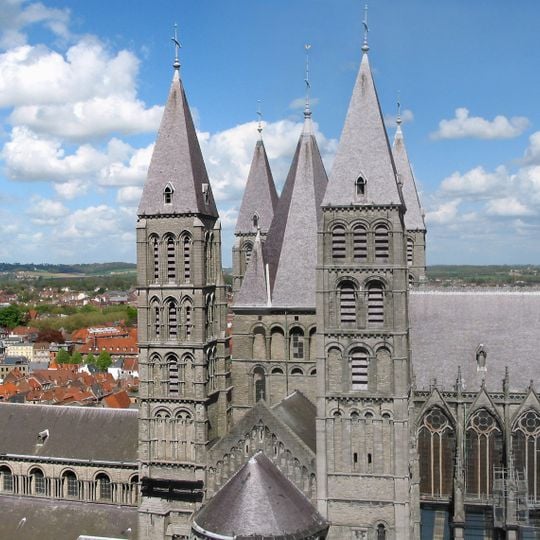
Tournai Cathedral, Roman Catholic cathedral in Tournai, Belgium
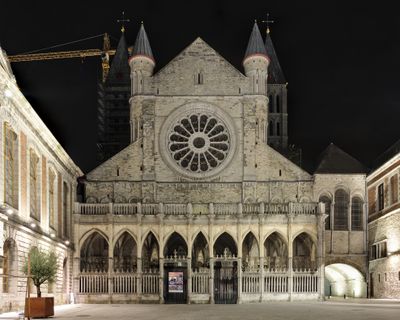
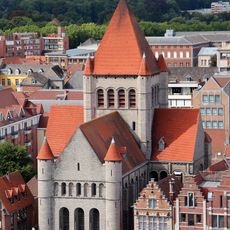
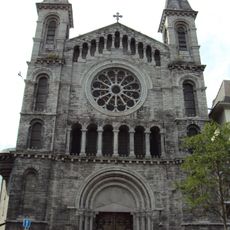
Tournai Cathedral is a Roman Catholic cathedral on rising ground near the south bank of the Scheldt. Its Romanesque nave, with a second-tier gallery and round-arched clerestory windows, contrasts with the transept, whose five square towers reach 83 metres and end in apses. The Gothic choir, begun in 1242, is as long as nave and transept together; a Gothic west porch fronts the facade with its rose window.
A first cathedral was built in the 5th century under Bishop Eleutherius; the present building was begun in the 12th century, west to east, with roof timbers cut between 1142 and 1150 and consecration on 9 May 1171. Bishop Gautier de Marvis demolished the Romanesque choir from 1242 and replaced it with the Gothic choir dedicated in 1255. Iconoclasts sacked the interior in 1566 and the French Revolution dispersed its furnishings; the western porch was added in the early 14th century.
The Grande Procession, held on the second Sunday of September, commemorates the end of a plague in 1092 and still leaves from the cathedral. Inside, the Renaissance rood screen carved by Cornelis Floris in 1573 and stained glass made by Arnold of Nijmegen in 1507 survive the iconoclast sack of 1566.
The cathedral stands on rising ground near the south bank of the Scheldt, in the historic centre close to the belfry and the Pont des Trous. The ground is soft and damp, and the building has been under repair and archaeological investigation since the 1999 tornado, so parts may be screened off. The western porch of the early 14th century is the usual entrance.
The cathedral has five bells, and the largest, Marie-Gasparine, was cast in 1843 and weighs 9 tons; Tournai residents also call it Marie-Pontoise. It hangs in the tower cluster, not inside the nave, so it is heard rather than seen by visitors.
The community of curious travelers
AroundUs brings together thousands of curated places, local tips, and hidden gems, enriched daily by 94,342 contributors worldwide.