Church of Saint Quentin, Romanesque church on Grand-Place, Tournai, Belgium
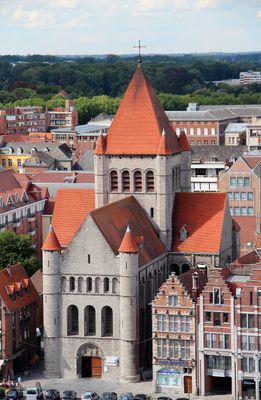
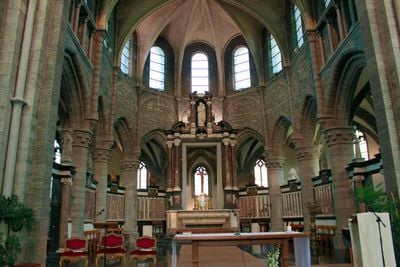
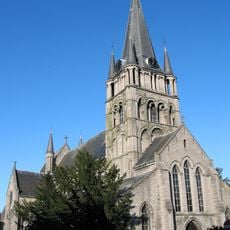
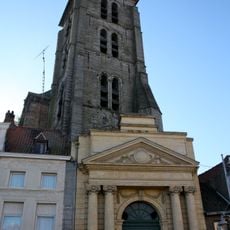
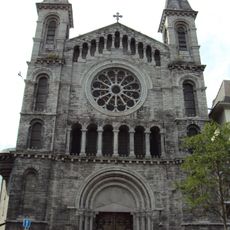
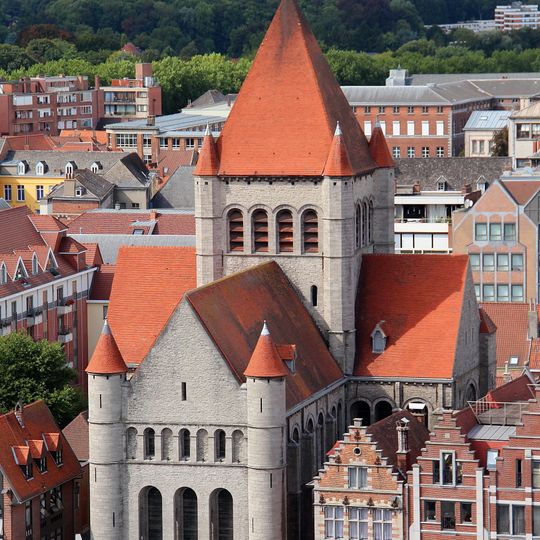
The Church of Saint Quentin is a Romanesque Catholic church at the far end of the Grand-Place in Tournai. Its pale grey stone exterior has steep orange-red tiled roofs, a square central tower with a pointed pyramidal roof and four corner turrets, and a rounded apse-like end with tall arched windows flanked by two round turrets. Inside, rib vaults cover the rounded apse, round columns with carved capitals support pointed arches, and a carved stone retable with a crucifix stands above the altar.
The original structure was built around 1200, and the chancel underwent reconstruction in the 15th century. Major restoration work was completed in 1968 following damage sustained during World War II.
The church is named after Saint Quentin, a 3rd-century Roman martyr. In 1464 the tapestry weaver Pasquier Grenier funded an ambulatory and three chapels; his coat of arms can still be seen on the chapel vaults. He donated a tapestry cycle of the Seven Sacraments, now dispersed to museums in New York, London and Glasgow. Since 2010 two 1428 Annunciation sculptures by Jean Delemer, painted by Robert Campin, have been displayed here.
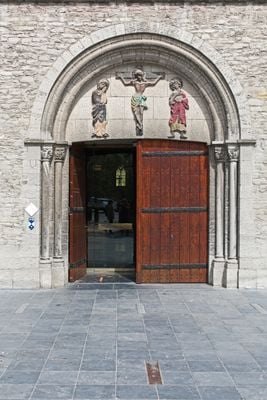
The church stands at the far end of the Grand-Place, its west facade facing the square. The nave is four bays long and leads to the crossing under the central tower; the chancel and ambulatory lie beyond. The Annunciation group of 1428 is displayed inside since 2010, and the 1987 Delmotte organ stands in the right transept.
The two Annunciation sculptures by Jean Delemer, painted by Robert Campin in 1428, were made for the nearby Saint Peter's church and only moved here on 25 March 2010. Carved in white Avesnes stone and about 1.80 m tall, they are considered the earliest example of the Late Gothic style that dominated Netherlandish sculpture for a century.
The community of curious travelers
AroundUs brings together thousands of curated places, local tips, and hidden gems, enriched daily by 94,021 contributors worldwide.