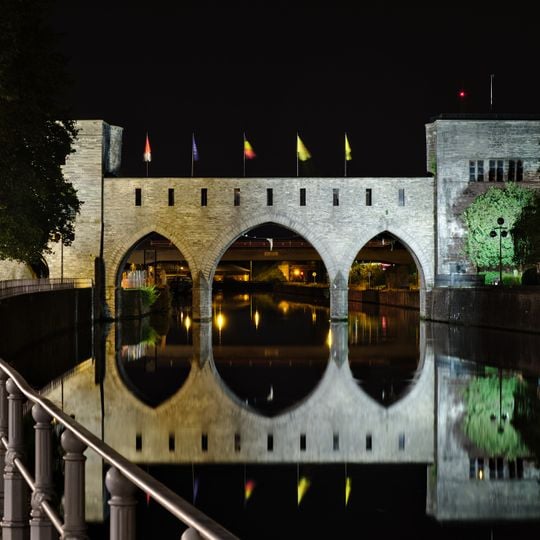
Bridge of the Holes

Log in to your account

AroundUs is a community-driven map of interesting places, built by curious explorers like you. It grows with every review, story, and photo you share.
Connect to save your favorite spots, contribute locations, and create personalized routes.
By continuing, you accept our Terms and Conditions and our Privacy Policy
Add to collection
Map
Suggest a change
Share

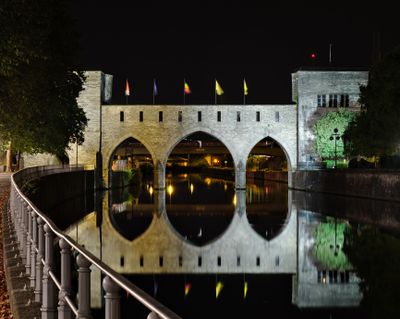
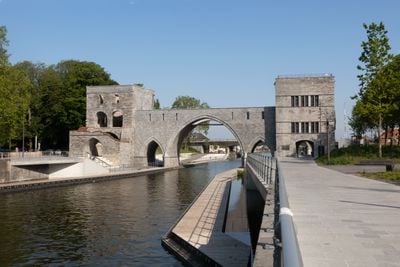
Bridge of the Holes, Gothic water gate in Tournai, Belgium

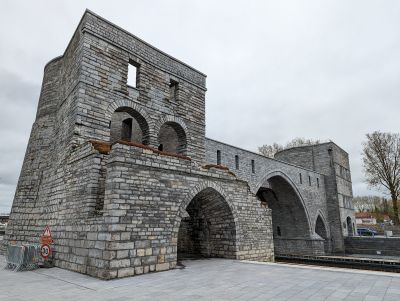
The stone bridge features three pointed arches spanning the Scheldt River, with two square defensive towers constructed from local limestone blocks.

Construction of the bridge began in 1281 during the medieval fortification of Tournai, taking 50 years to complete the towers and connecting arches.

The bridge represents a rare example of medieval military architecture in Belgium, forming part of the second defensive wall system of Tournai.

Visitors can view the bridge from multiple angles along the riverbank paths, with optimal photography conditions occurring during morning and evening hours.

The structure contained a mechanical portcullis system that could block river traffic, making it one of the few remaining medieval water gates in Europe.

Location: Tournai

Inception: 1281

Architectural style: Gothic art

Part of: city walls of Tournai

Address: Quai Donat Casterman, 7500 Tournai, Belgium

Website: https://archeologia.be/pontdestrous-historique.html

GPS coordinates: 50.61300,3.38379

Latest update: June 19, 2025 10:09

Stone bridges and historic aqueducts: Europe, Asia, Roman structures

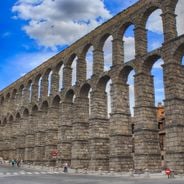
Stone arch bridges rank among the most durable structures in history. From Roman aqueducts in Spain to medieval river crossings in Central Europe, these constructions demonstrate the evolution of engineering over two millennia. The Pont du Gard in France once transported 20,000 cubic meters of water daily over 50 kilometers, while the Segovia Aqueduct in Spain was built without mortar. In Asia, stone bridges like the Marco Polo Bridge in China have connected trade routes for centuries. The Khaju Bridge in Isfahan functions simultaneously as a dam and public gathering space. These structures served multiple purposes: transport, water supply, and social meeting points. Many of these bridges and aqueducts remain in use today. They document various construction techniques, from Roman concrete vaults to Persian brick arch structures. The constructions have survived wars, earthquakes, and floods, remaining functional elements of modern infrastructure.

Reviews

Visited this place? Tap the stars to rate it and share your experience / photos with the community! Try now! You can cancel it anytime.

« Bridge of the Holes - Gothic water gate in Tournai, Belgium » is provided by Around Us (aroundus.com). Images and texts are derived from Wikimedia project under a Creative Commons license. You are allowed to copy, distribute, and modify copies of this page, under the conditions set by the license, as long as this note is clearly visible.

Discover hidden gems everywhere you go!

From secret cafés to breathtaking viewpoints, skip the crowded tourist spots and find places that match your style. Our app makes it easy with voice search, smart filtering, route optimization, and insider tips from travelers worldwide. Download now for the complete mobile experience.

Around Us App Screenshot

A unique approach to discovering new places

Le Figaro

All the places worth exploring

France Info

A tailor-made excursion in just a few clicks

20 Minutes