Vierendeel bridge of Laeken, railway bridge in Brussels, Belgium
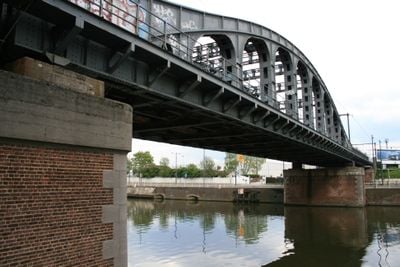
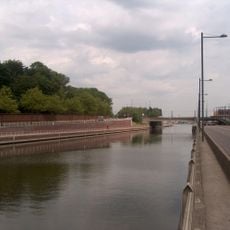
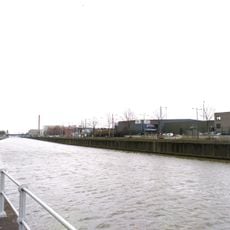
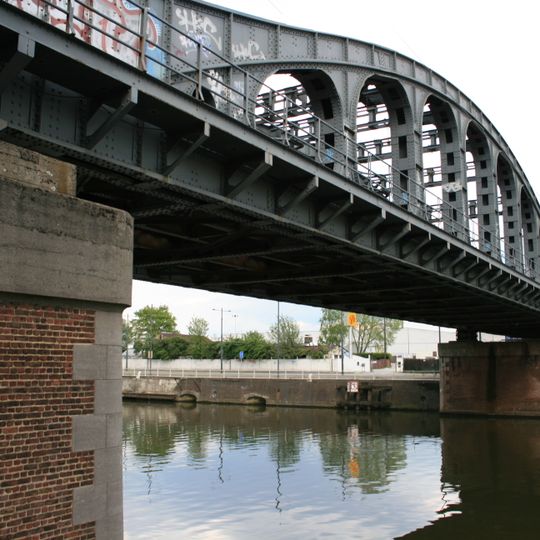
The Vierendeel bridge of Laeken is a riveted steel railway bridge over the Willebroeck canal in Brussels, with a span of 53.8 m and a width of 11.7 m. Two Vierendeel girders flank the deck, their large arched openings tied by a lattice of diagonal braces along the lower edge. The left end rests on a concrete and brick abutment.
The original bridge dated from the early 1900s and could rotate to let ships pass, but was destroyed in 1940 during bombing raids. The current bridge was rebuilt in 1942 as a fixed structure and has carried trains over the canal ever since.
The bridge takes its name from Arthur Vierendeel, the Leuven-born engineer whose 1896 patent replaced diagonal bracing with rigid rectangular frames; the type is called a Vierendeel truss in his honour. Its 1942 steel span over the Willebroeck canal is one of the structures that carried his system into Belgian railway practice.
The bridge is not open to pedestrians or vehicles, as it is reserved exclusively for train traffic. You can view it from nearby roads or from the banks of the Willebroeck canal to observe its structure up close.
The bridge rests on fixed supports on one side and rolling supports on the other, allowing it to expand and contract with temperature changes. This simple engineering detail has allowed the structure to function for over 80 years without major modifications.
The community of curious travelers
AroundUs brings together thousands of curated places, local tips, and hidden gems, enriched daily by 94,108 contributors worldwide.