Pont Atlas, Liège, Concrete arch bridge in Liège, Belgium
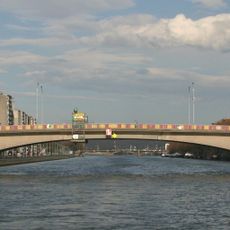
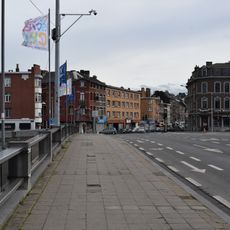
Pont Atlas is a reinforced concrete bridge over the Meuse at Droixhe, with a low horizontal deck carried on three broad arches formed by paired curved ribs. The ribs spring from thick vertical piers standing in the water, and the weathered grey concrete shows darker streaks. A lighter parapet runs along the deck, lined with lamp posts on curved arms and small rectangular signs.
The first bridge here, the Pont de Coronmeuse, was built between 1927 and 1930 as a 315-metre crossing of the Dérivation, the Meuse and the Maastricht canal, a remnant of Liège's 1930 International Exhibition marking Belgium's centenary. It was destroyed on 11 May 1940 at the start of World War II. The replacement opened in 1947 and was named after the tug Atlas V.
The bridge is named after the tugboat Atlas V, which on 3 January 1917 left this bank at midnight with 103 passengers, including 94 recruits for the front, and reached Dutch Eisden. Its captain, Jules Hentjens, led the escape past German barriers.
The bridge carries a busy road linking Coronmeuse with Droixhe and Bressoux. Pedestrians cross on a walkway beside the traffic; the parapet and lamp posts line the deck. Look for the memorial plaque on the bridge, which records the Atlas V's 1917 passage.
A memorial plaque on the bridge reproduces the departure text: on 3 January 1917 at midnight, the tug Atlas V left this bank under enemy occupation, carrying 103 passengers including 94 recruits for the front. Commanded by Captain Jules Hentjens, it reached Eysden in the Netherlands after breaking through barriers.
The community of curious travelers
AroundUs brings together thousands of curated places, local tips, and hidden gems, enriched daily by 93,408 contributors worldwide.