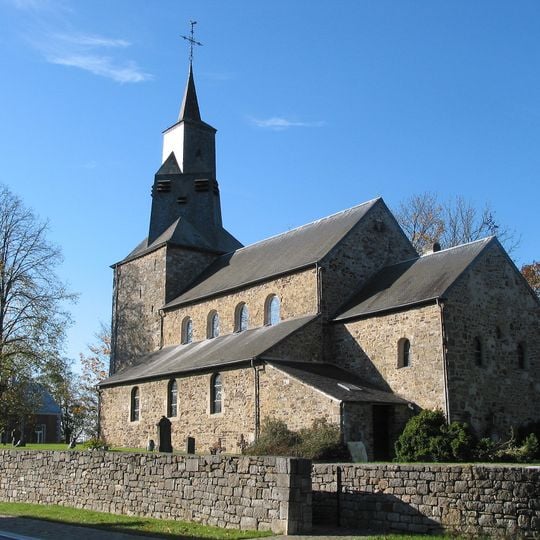
Église Saint-Étienne de Marche-en-Famenne, 11th century Romanesque church in Waha, Belgium
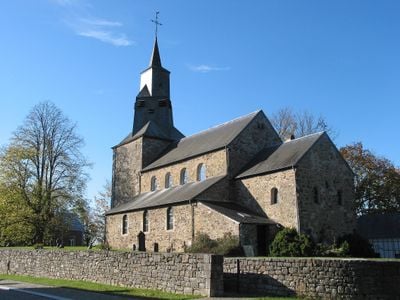
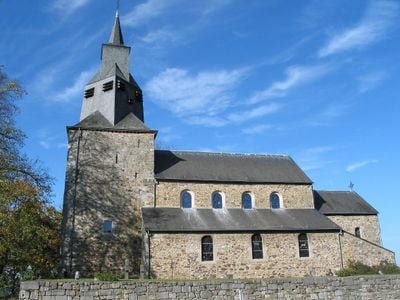
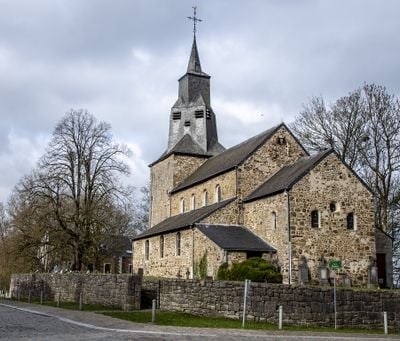
The Église Saint-Étienne de Marche-en-Famenne is a church in Waha village with stone walls and Romanesque design from earlier centuries. Modern stained glass windows created by Jean-Michel Folon in the 2000s shape how the interior looks and feels today.
A Latin dedication stone records the church's consecration on 20 June 1050 by Theoduin, prince-bishop of Liège. The central nave with its massive square piers is the oldest part; the bell tower replaced an earlier porch around 1200, and its spire was rebuilt in 1574 after collapsing in 1627. The interior was restored to its Romanesque state in 1957–62 under Roger Bastin, and the building was listed as exceptional Walloon heritage in 2013.
The church keeps a 13th-century reliquary of Saint Stephen, said in a 17th-century manuscript to have been given by Henri Costerius. The blue-stone font of 1590, carved with the four rivers of paradise, was donated by Marie, daughter of Hubert de Hesdre. Sixteen windows by Jean-Michel Folon, made in 2003-2005, show scenes from the Acts of the Apostles and later legend; Folon died before their inauguration.
The site lies around 2 kilometers from Marche-en-Famenne town center and can be reached on foot or by bus. Keep in mind this is an active place of worship where respectful behavior is expected during visits.
The church keeps the largest known group of works by the anonymous 16th-century sculptor called the Master of Waha, including a polychrome oak Saint Barbara and a calvary with Christ, Mary and John, dated 1510. The two fragments of the 1050 dedication stone were only recognised in 1844 in the floor and in 1896 in a door frame.
The community of curious travelers
AroundUs brings together thousands of curated places, local tips, and hidden gems, enriched daily by 94,099 contributors worldwide.