Rochefort Abbey, Trappist monastery in Rochefort, Belgium.
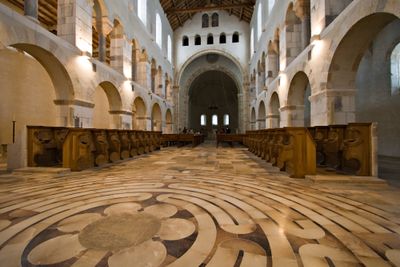
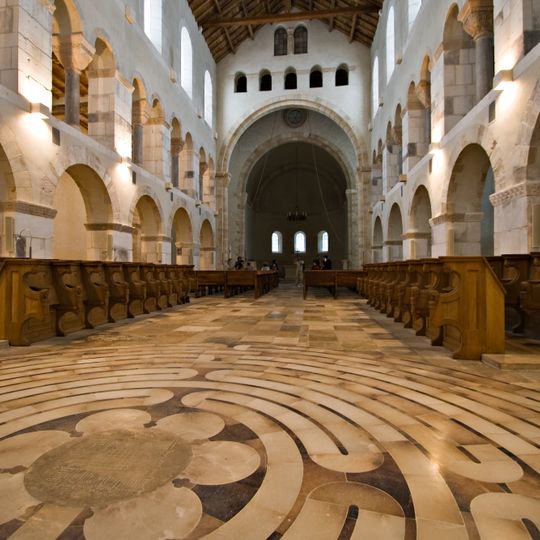
Rochefort Abbey is a Trappist monastery whose church interior has a long central aisle paved with concentric rings of light beige and darker brown stone around a mottled central medallion. Plain wooden pews with carved, curved bench ends line both sides. Grey stone walls are pierced by round-arched openings and clerestory windows, and a tall rounded arch frames three small windows above the altar area beneath a timber roof.
Gilles de Walcourt, count of Rochefort, founded a Cistercian nunnery called Secours de Notre-Dame in 1230. In 1464 the chapter of Cîteaux replaced the nuns with monks from Félipré, making the house a direct daughter of Cîteaux. Calvinist troops plundered it in 1568 and soldiers of Don Juan of Austria in 1577; the monks began brewing in 1595. After the French Revolution the abbey was sold in 1797 and demolished around 1805.
The abbey maintains a centuries-old tradition of monastic beer brewing that has become central to its identity and economic life. Visitors encounter this legacy in local shops where the product connects the religious community to people beyond the monastery walls.
The abbey is a cloistered community: only a limited part of the buildings is open to guests, and the brewery itself is not open to the public. The monks rise at 3 a.m., eat no meat and speak only when necessary, so visitors should keep to the areas set aside for them. The 16th-century portal, the 17th-century farm buildings and the 18th-century watermill survive from before the French Revolution.
The abbey's motto, Curvata Resurgo ("bent, I rise again"), comes from the coat of arms of Abbot Philippe Fabry, who led the rebuilding after the wars of the 17th century and had the church reconsecrated in 1671. The same motto still serves the community today.
The community of curious travelers
AroundUs brings together thousands of curated places, local tips, and hidden gems, enriched daily by 94,364 contributors worldwide.