Château de Rochefort, Medieval fortress in Rochefort, Belgium.
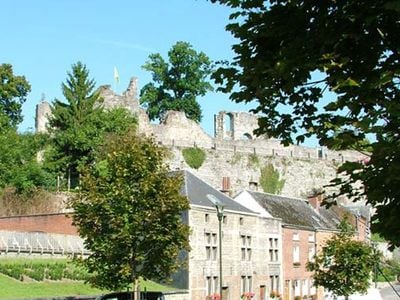
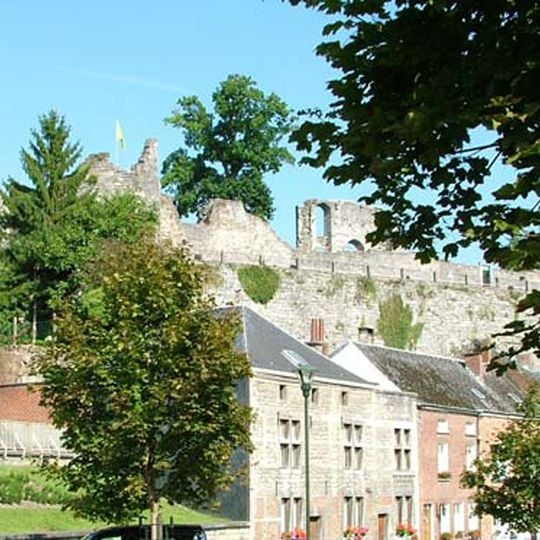
The Château de Rochefort stands in ruins on a rocky ridge above a bend of the Lomme south of Rochefort. Rough grey and tan masonry forms a long, uneven lower wall pierced by small openings, with broken wall fragments above it: a stubby rounded remnant with a flagpole on the left, a weathered central mass, and a taller section on the right with two large arched window openings. The oldest parts, including the keep, date from the 12th century.
The first lords, the Montaigu family, built a fortress on the hilltop at the end of the 11th and start of the 12th century; only the oldest walls and the keep survive. A first written mention dates from 1155. The castle passed through the Duras, Walcourt, La Marck, Stolberg and Löwenstein families, who strengthened it. In 1732 an imperial court decision gave castle and lands to the Stolbergs, and after 1795 the French sold it as national property; it was then quarried for building stone.
The name Rochefort derives from 'Rocha Fortis', meaning fortified rock, after which the settlement below the castle was named. The Walcourt family coat of arms became the town's own, and in 1285 Thierry of Walcourt granted the burghers a charter making the growing town politically independent. The counts of Rochefort held most of their land as vassals of the count of Luxembourg.
Visitors should wear sturdy footwear since the uneven stone surfaces and hillside terrain require careful footing. Tours can be arranged in advance, and information about scheduling is available through the site's contact number.
The castle gave its name to Rochefort, from Latin Rocha Fortis, meaning fortified rock. The counts of Rochefort held most of their land as vassals of the count of Luxembourg, and the Walcourt family coat of arms became the town's own.
The community of curious travelers
AroundUs brings together thousands of curated places, local tips, and hidden gems, enriched daily by 93,787 contributors worldwide.