Royal Castle of Ciergnon, Royal summer residence in Houyet, Belgium
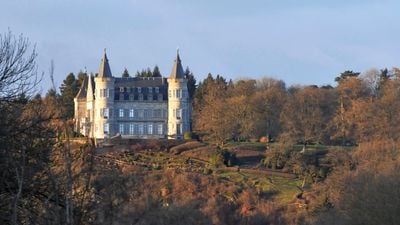
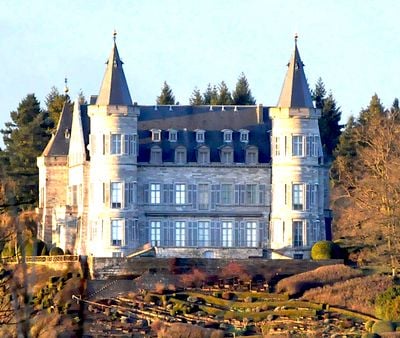
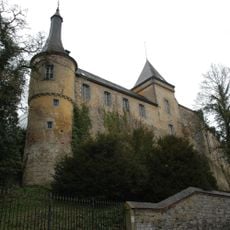
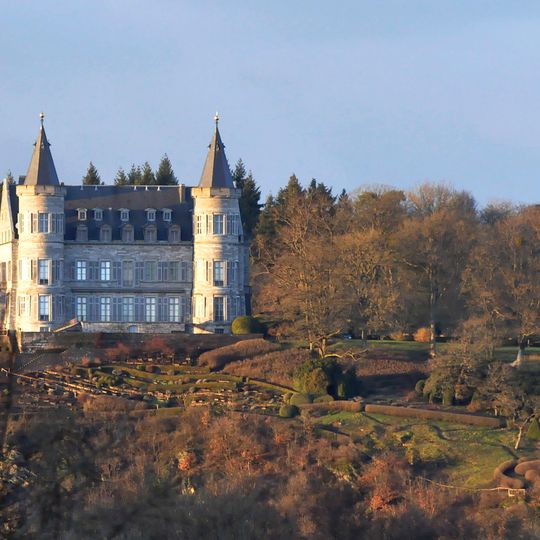
The Royal Castle of Ciergnon stands on a rock above the Lesse river near Houyet in Namur province, Wallonia. Its pale stone central block has a dark hipped roof with dormer windows and tall chimneys, flanked by two round corner towers with steep grey conical roofs. A balustraded terrace runs along the base of the left wing above clipped hedges and paths.
King Leopold I bought the Ciergnon estate in May 1840 at the request of Queen Louise-Marie, whose doctors believed the air would benefit her fragile bronchi. He had a hunting pavilion built to plans by architect Henri Joseph Duvinage. In 1888 Leopold II had court architect Alphonse Balat transform it into a true castle, giving it its present form, while Élie Lainé designed the gardens. In 1903 the estate passed to the Belgian state under the Royal Donation.
The castle chapel hosted the baptism ceremonies of the four children of King Philippe and Queen Mathilde. The residence also served as the setting where King Baudouin presented his fiancée Fabiola de Mora y Aragón to the press in 1960, and where Albert II celebrated his sixtieth birthday in 1994.
The castle is owned by the Donation royale and is not open to the public; it is used by the royal family and their guests on weekends. The wooded domain around Ciergnon, with its hunting grounds along the Lesse, can be seen from the surrounding area, but the building itself cannot be visited.
The estate was bought in 1840 at the request of Queen Louise-Marie, whose doctors believed the Ardenne air would help her fragile bronchi. The forests around the castle are known for wild boar, and the grounds were chosen as hunting country above the Lesse valley.
The community of curious travelers
AroundUs brings together thousands of curated places, local tips, and hidden gems, enriched daily by 94,259 contributors worldwide.