Gouffre de Belvaux, Sinkhole in Han-sur-Lesse, Rochefort, Belgium
The Gouffre de Belvaux is the sinkhole where the Lesse disappears into the Boine limestone massif in Han-sur-Lesse. Its arch opens into a dark recess, with a stream flowing out over pale rounded stones. The shaft bottom lies 45 metres down, reached by diving in 1964.
Bob Destreille reached the bottom of the shaft at -45 metres on 6 September 1964. In 1971 diver Daniel Ameye disappeared in the sump and was never found. From 1964 to 1972 the SCUCL cleared the Drève des Étançons, giving access to over 500 metres of navigable underground Lesse. In 1987 Claude Grandmont made the sump connection between the tourist caves and the known end of the underground river.
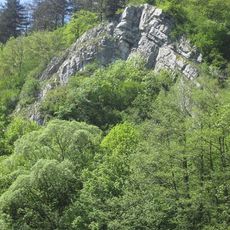
The sinkhole lies inside the animal reserve of the Domaine des grottes de Han, on the Lesse at Han-sur-Lesse. The name Belvaux refers to the old entrance of the Lesse, whose porch now opens onto the Drève des Étançons slope. The water that vanishes here reappears about 24 hours later at the trou de Han, on the far side of the Boine massif.
The sinkhole lies in the animal reserve of the Domaine des grottes de Han, so it is not open to individual visitors; it is reached on foot from the Han caves area, across the Boine massif. Access to the water and the 45-metre shaft is reserved for cavers and divers. The Lesse can flood the depression of the Chavée in winter, when its flow exceeds the sinkhole's 27 cubic metres per second.
During winter months, the river can overflow its underground capacity and temporarily return to the surface. These rare flood events follow the ancient riverbed path around the nearby Boine Massif, revealing how water has shaped the landscape over millennia.
The community of curious travelers
AroundUs brings together thousands of curated places, local tips, and hidden gems, enriched daily by 93,693 contributors worldwide.