Courtrai Newfoundland Memorial, War memorial in Kortrijk, Belgium
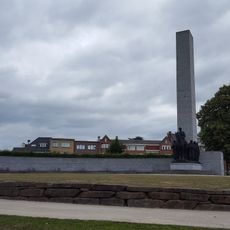
The Courtrai Newfoundland Memorial is a bronze caribou with raised, branched antlers standing on a rough-hewn cairn of Newfoundland granite. It faces the direction the Newfoundlanders attacked and bears a bronze plaque reading "COURTRAI, 1918". The memorial stands in a small park planted with species native to Newfoundland and Labrador, on the northwest side of the Gentsesteenweg (N43), about 25 metres from its junction with the R8.
The memorial commemorates the Royal Newfoundland Regiment's actions in the final months of the First World War, including the crossing of the Lys/Leie at Kortrijk on 20 October 1918. The bronze caribou, designed by Basil Gotto, was cast by the Compagnie des Bronzes and inaugurated in 1924 on what was then Harelbeke territory. Responsibility passed to the Canadian government in 1949 when Newfoundland joined Canada.
The memorial serves as a gathering place where Canadians and Belgians come together to honor soldiers from Newfoundland who fought in World War I. People visit this site especially on commemorative dates to express their connection to this shared history.
The memorial is accessible by car from Kortrijk city center, with parking available near the cemetery site. Plan to spend time walking around the grounds to fully appreciate the location and its surroundings.
The caribou is one of six memorials erected in Europe by the Newfoundland government, and the only one in Belgium; the others stand at Beaumont-Hamel, Gueudecourt, Masnières and Monchy-le-Preux in France and at Gallipoli. A seventh caribou, given by Major William Howe Greene, stands in Bowring Park, St. John's. Locals call the Kortrijk statue Den Hert, and it appears in Hugo Claus's novel Het verdriet van België.
The community of curious travelers
AroundUs brings together thousands of curated places, local tips, and hidden gems, enriched daily by 94,427 contributors worldwide.