Saint Sophia Church, Eastern Orthodox church in Oborishte District, Sofia, Bulgaria
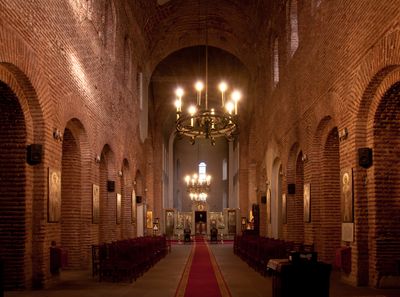
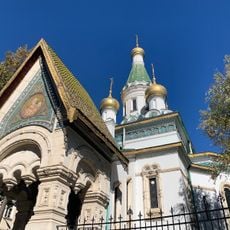
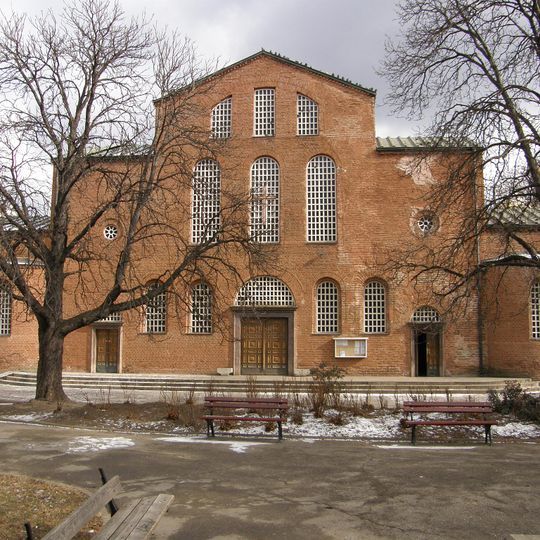
Saint Sophia Church is a red-brick cross basilica with a central nave 7.70 m wide, two side naves of 4.30 m, and a transept 23 m long; the central nave rises 16.10 m and the dome 19.75 m. Its total length is 46.45 m and width 20.20 m. The facade has a round window on the right and arched windows with latticework; inside, brick arches and a barrel-vaulted ceiling frame a wooden iconostasis. The bell hangs from a centuries-old tree in the garden.
The present cross-domed basilica is attributed to the reign of Justinian I (527–565), though 20th-century scholars also proposed Marcian or Leo I. It stands over at least four earlier churches, the first a martyrium built after the Edict of Milan with an altar dated to the mid-4th century. After the Ottoman conquest it became a mosque, was restored by Siyavush Pasha, and was abandoned after earthquakes in 1818 and 1858.
The name derives from Holy Wisdom, one of the names of the young Jesus Christ, as in Constantinople's Hagia Sophia. The first written record of the name appears in a 1329 gospel annotation, and by the 14th century the city itself took the name Sofia. Icons inside show Sophia as Christ Emmanuel, a young Christ seated on a rainbow.
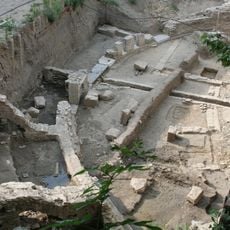
Visitors can access both the main church space and the underground level where ancient tombs and archaeological remains are displayed. Both areas are connected and can be explored together during a single visit.
The building served completely different purposes over the centuries, functioning as a mosque during Ottoman occupation and later as a fire brigade watchtower in the 19th century. This shifting history of use shows how adaptable and durable the structure proved to be.
The community of curious travelers
AroundUs brings together thousands of curated places, local tips, and hidden gems, enriched daily by 95,511 contributors worldwide.