Amphitheatre of Serdica, Roman amphitheatre in Oborishte District, Sofia, Bulgaria
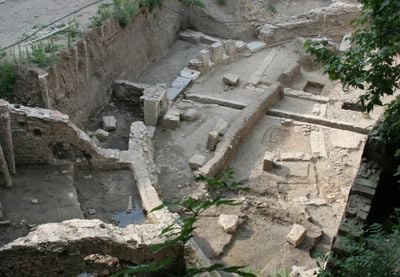
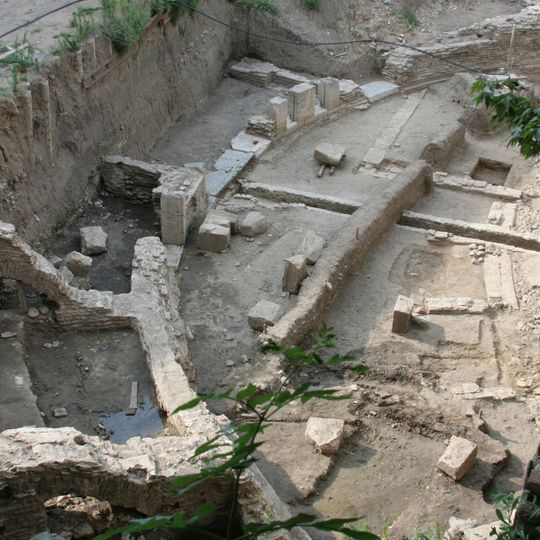
The Amphitheatre of Serdica lies in central Sofia as two exposed excavation sites. Its curved wall of grey-beige stone and brick masonry encloses an arena measuring 60.5 by 43 metres, with a curved inner passage and scattered rectangular stone blocks on the bare earth floor. Low wall foundations and rectangular pits stand to the right, while a taller rubble wall and a curved bank of seating steps rise behind.
Construction began in the late 3rd century under Emperor Diocletian and continued into the early 4th century under Constantine. Later the complex fell into disuse as the city expanded and its stones were taken for other buildings.
The name Serdica recalls the Roman settlement whose residents gathered here to watch contests and animal displays. Today parts of the seating lie below street level, and the open sections show how the city grew over the ancient remains.
Part of the ruins is built into the Arena di Serdica Hotel, where you can view coins and ceramic finds displayed in cases. The site is best visited in the morning when light reveals the stone walls clearly.
Among the finds were clay stones imprinted with the footprints of goats, dogs and cats, and hundreds of bronze coins. A rare bronze medallion of Antinous also came from the site. The 1919 stone plate showing gladiators and wild animals, now in the National Archaeological Institute with Museum, first hinted at the amphitheatre's existence.
The community of curious travelers
AroundUs brings together thousands of curated places, local tips, and hidden gems, enriched daily by 94,973 contributors worldwide.