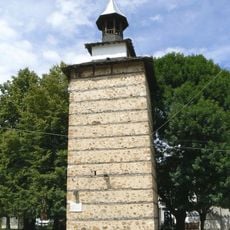
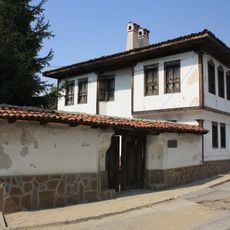
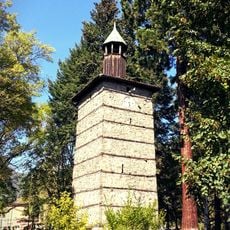
Etropole Monastery, Orthodox monastery in the Balkan Mountains, Bulgaria
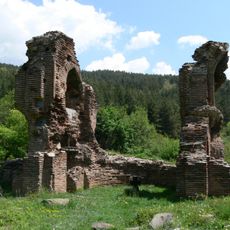
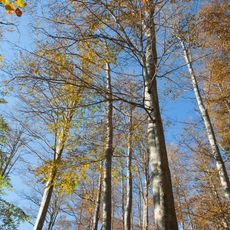
Etropole Monastery of the Holy Trinity, also called Varovitets, stands among maple woods at the foot of the Balkan Mountains. Its main church, built in 1858–1859 by architect Ivan Boyanov of Bratsigovo, is a cruciform three-naved structure with five hexagonal turret domes; interior frescoes date from 1896 to 1907. Two chapels, dedicated to Saint John the Baptist and Saints Cosmas and Damian, and National Revival residential buildings surround a grass-covered yard.
This monastery was founded in 1158 and became a major religious and cultural center throughout the medieval period. In the 19th century, it sheltered Vasil Levski, a key figure in Bulgaria's struggle for independence from Ottoman rule.
The monastery's name Varovitets comes from the limestone used to build its church. Its scriptorium produced manuscripts in the Etropole calligraphic semi-uncial, a stylised renewal of the oldest Cyrillic script. The monastery keeps a 1598 Holy Trinity icon by the teacher Nedyalko of Lovech and celebrates its feast on Pentecost.
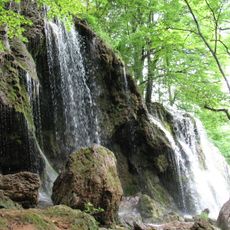
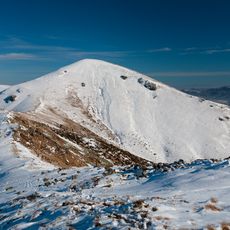
The monastery lies 5 km from Etropole and 4 km east of Ribaritsa, at the foot of Black Peak (1,070 m). It is among the 100 National Tourist Sites of the Bulgarian Tourist Union, and a stamp is available in the church. The Varovitets waterfall and its karst spring are in the woods nearby.
The monastery preserves a collection of rare treasures, including two silver-decorated crosses from the 15th century with intricate detail work. These precious objects demonstrate the craftsmanship and artistic skill that flourished within this religious community.
The community of curious travelers
AroundUs brings together thousands of curated places, local tips, and hidden gems, enriched daily by 93,963 contributors worldwide.