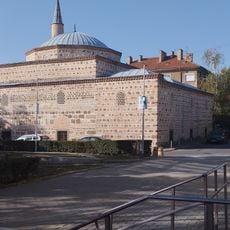
Tuida, Archaeological museum and fortress at Hisarlaka hill in Sliven, Bulgaria
Tuida is a ruined early Byzantine fortress on Hisarlaka hill in northeastern Sliven, near the Novo selo quarter. Its walls, corner towers, north and south gates, and foundations of residential and military buildings stand on a site of about 40 decares. The masonry uses opus incertum mixtum with bands of brick.
A late Iron Age settlement (6th–1st century BC) stood here before becoming the Roman market town of Tuida, recorded in the 3rd century AD and listed by Hierocles among the four cities of Haemimontus. After the capital moved to Constantinople the hill was fortified with walls in opus incertum mixtum, with three brick bands and buttresses. The fortress survived the Gothic invasion of 378 but was destroyed by the Huns in the 5th century, then rebuilt under Anastasius I (491–518) with five brick bands and added stone stairways. It was destroyed again around 598–599, probably by Avars and Slavs.
The museum displays medieval clothing, traditional crafts, and everyday objects from the First Bulgarian Kingdom era. You can observe how these items were made and used in daily life through the exhibits.
The site is best explored on foot at your own pace, with visits varying in length depending on your interests. Sturdy shoes are recommended, as pathways are uneven and the climb to the hilltop can be steep.
Archaeozoological study of bones found at the settlement identified 14 species of wild and domestic birds, from which the site's later bird collection was wrongly inferred. Excavations resumed in 2004 after a pause, aiming at conservation and display of the walls, corner towers and gates as a visitor attraction.
The community of curious travelers
AroundUs brings together thousands of curated places, local tips, and hidden gems, enriched daily by 94,027 contributors worldwide.