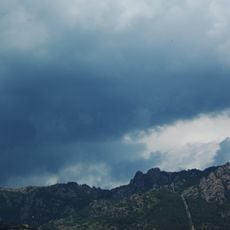
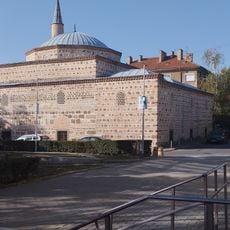
Скално светилище Зайчи връх, Megalithic sanctuary near Kabile, Bulgaria
The Zaychi Vruh rock sanctuary is an ancient megalithic site near Kabile featuring two perpendicular trenches carved into a rocky plateau. These trenches extend approximately 12 meters east-west and 15 meters north-south, representing an impressive engineering achievement of the ancient builders.
The settlement that preceded ancient Kabile grew up around the sanctuary at the end of the 2nd millennium BC, and pottery from the 10th–6th centuries BC shows it continued into the early Iron Age. Archaeoastronomical study of the carved trenches points to sunrises at the equinoxes being observed between 2000 and 1500 BC, with the site probably in use until the 3rd–1st centuries BC.
The name Zaychi Vrah comes from the Turkish Taushan Tepe, both meaning Hare's Peak. Bulgarian archaeologist Prof. Velizar Velkov considered this the oldest sanctuary where a rock bears a relief image of the Great Mother of the Gods, Cybele, later Artemis on a lion. The relief is thought to lie at the crossing of the two trenches.
The sanctuary lies on the eastern part of the two-headed Zaychi Vrah hill, above the ruins of Kabile and the Tundzha river bend. The rock-cut trenches are reached on foot over uneven ground; sturdy footwear helps. From the trench intersection the distant horizon lies 4–8 km away and about 1° above the mathematical horizon.
The trenches follow precise astronomical alignments with cardinal directions, with specialized observation areas that allowed tracking of seasonal solar movements. This arrangement reveals the builders possessed sophisticated knowledge of celestial mechanics.
The community of curious travelers
AroundUs brings together thousands of curated places, local tips, and hidden gems, enriched daily by 94,931 contributors worldwide.