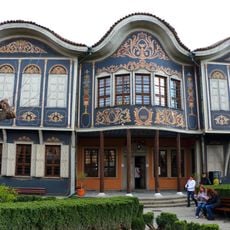
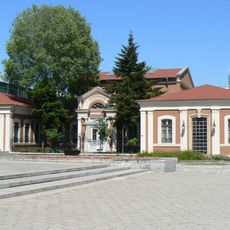
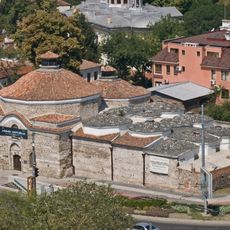
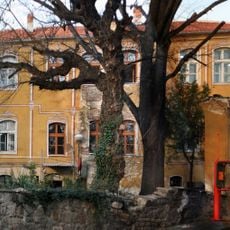
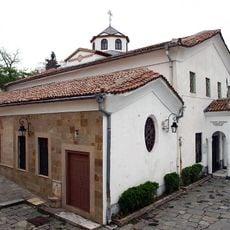
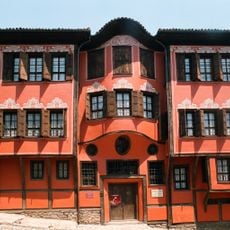
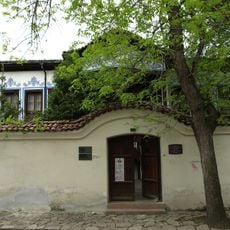
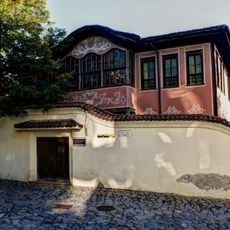
Hindliyan house, Revival-era museum in Central District, Plovdiv, Bulgaria.
Hindliyan House is a Revival-period museum and building in the Central District of Plovdiv. Its interior features detailed wall murals depicting international cities, intricately patterned wooden ceilings, and traditional European architectural elements throughout.
The house was built between 1835 and 1840 by an unknown master for the wealthy merchant and landowner Stepan Hindliyan. In 1915, at the start of the Armenian genocide, the Hindliyan family left the house and gave it as shelter to Armenian refugees. In 1974 it was declared a cultural monument, restored and furnished with Revival-period furniture.
The name of the house comes from its owner, the Armenian merchant Stepan Hindliyan. The murals by the Chirpan masters Moko and Mavrudi, who worked for over six months, show cities such as Istanbul, Venice, Alexandria, Stockholm, Copenhagen and Saint Petersburg. Above the cellar door a mirrored image of the house serves as a plan of the building.
The house stands at ulitsa "Artin Gidikov" 4, on the western slope of Nebet tepe in Old Plovdiv, in a large courtyard opening onto three streets. It forms one exhibition unit with the neighbouring Balabanov House, where the "Old Town Life" display continues. The two-storey building is entered from the courtyard; the bath, kitchen and stone storeroom stand in the yard itself.
The bath in the courtyard, linked directly to the house, has domes, vaults, marble flooring and underfloor heating, and is the only surviving Revival-period bath in Bulgaria with running hot and cold water. Above the cellar door a painted mirror image of the house serves as a kind of floor plan.
The community of curious travelers
AroundUs brings together thousands of curated places, local tips, and hidden gems, enriched daily by 94,012 contributors worldwide.