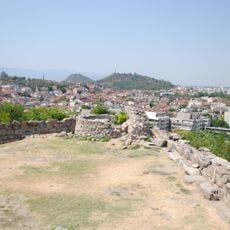
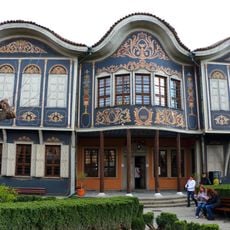
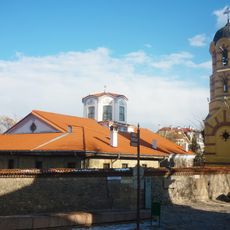
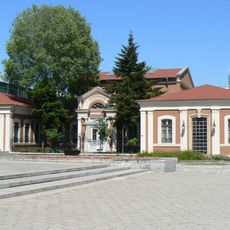
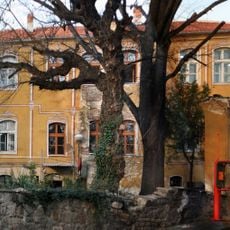
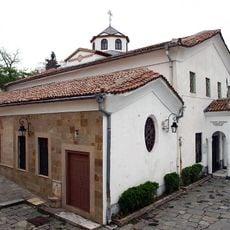
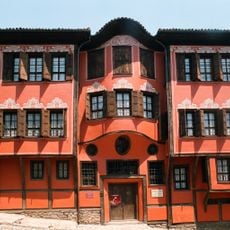
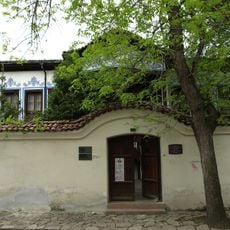
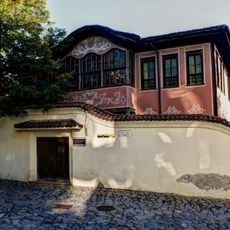
Hisar Kapia, Medieval gate in Old Town, Plovdiv, Bulgaria.
Hisar Kapia is a medieval gate in Plovdiv's Old Town, built over the foundations of a Roman gate from the 2nd century AD. Its present form dates from between the 11th and 14th centuries. Above the arch, stones are framed with pieces of red brick and bonded with white mortar, a technique typical of the Second Bulgarian Empire.
A first gate stood here in the 2nd century AD; Justinian strengthened the fortifications in the 6th century. The present structure took shape between the 11th and 14th centuries, with masonry of stone and red brick set in white mortar above the arch. After the Ottoman invasion it lost its defensive role, and in the 17th–18th centuries merchants built houses over the walls. It was reinforced in the early 20th century.
The name comes from Turkish Hisar Kapı, meaning "Castle Gate". The gate was one of three entrances to the acropolis of ancient Plovdiv, together with the northern and southern gates. In the 17th and 18th centuries, wealthy merchants built their houses directly over the ruined fortification walls, and the lower floors of these houses still incorporate the old stonework.
The gate is centrally located in the Old Town and easy to reach on foot while exploring the narrow cobbled streets. It serves as a natural meeting point and connects several walking paths through the historic quarters.
The gate's arch shows the masonry of the Second Bulgarian Empire: each stone framed by pieces of red brick and set in white mortar. In the 17th and 18th centuries, wealthy Plovdiv merchants built their houses directly on the surviving fortress walls, so the lower floors of these houses are the old ramparts themselves.
The community of curious travelers
AroundUs brings together thousands of curated places, local tips, and hidden gems, enriched daily by 94,227 contributors worldwide.