Eirene Residence, Roman peristyle house ruins in Plovdiv, Bulgaria
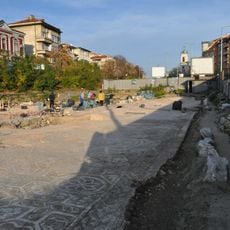
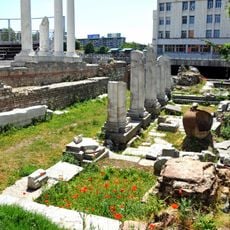
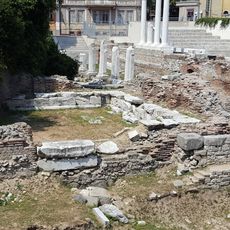
Eirene Residence is a Roman peristyle house built in the mid-3rd century AD in Philippopolis, now Plovdiv. It occupies a whole city block, with residential rooms around a colonnaded courtyard in the east and service rooms in the south. The excavated area covers 668 square meters, including 160 square meters of mosaics.
Built around the middle of the 3rd century AD, probably after the Gothic sack of Philippopolis in 251, the house rose over the ruins of earlier dwellings and filled a whole insula. Attila's Huns damaged it in 441–442; it was then repaired and enlarged, with mosaic floors laid between the 4th and 5th centuries. It was abandoned at the end of the 6th century.
The residence takes its name from the goddess Eirene, depicted in a mosaic within the main room, with Greek inscriptions welcoming guests throughout the different spaces. These inscriptions and images show how wealthy residents displayed their education and prosperity.
The remains lie in the archaeological underpass of Tsar Boris III Boulevard, where the paved Roman street is also displayed. Access is through the TrakArt cultural complex, which opened the site to the public in 2003. The floor mosaics are set in the ground underfoot, so watch your step along the walkways.
The central room's mosaic portrait of Eirene was made in opus vermiculatum, using small, irregularly shaped tesserae, and carries the Greek inscription EIRHNH beneath the figure. The octagonal marble basin at the centre of the floor worked as a fountain. The house was found in 1983–1984 while the Tsar Boris III Boulevard underpass was being built.
The community of curious travelers
AroundUs brings together thousands of curated places, local tips, and hidden gems, enriched daily by 94,101 contributors worldwide.