Bishop's Basilica of Philippopolis, Early Christian basilica museum in Plovdiv, Bulgaria
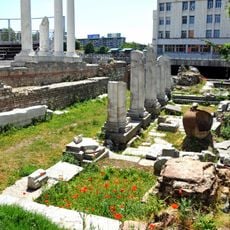
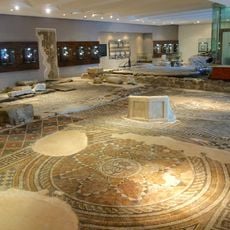
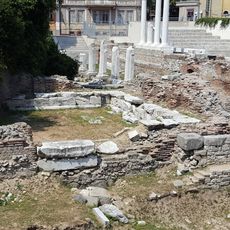
The Bishop's Basilica of Philippopolis is a ruined early Christian church in Plovdiv, built in the mid-4th century AD. It measures 86.30 m by 38.50 m and has a central nave, two side aisles, an apse, a narthex and an atrium. Its floor mosaics cover 2,000 sq. m and are displayed on two levels in a museum opened in 2021.
The building was constructed in the middle of the 4th century and served as an active church for several generations until the end of the 6th century. After that time it was converted into a burial ground and its role as a place of worship came to an end.
The mosaics include 20 recognised bird species, seven of them exotic, such as the Egyptian goose, helmeted guineafowl and Alexandrine parakeet. Prof. Zlatozar Boev's 2018 study argued these African birds could only have been depicted from live specimens, implying they were brought to Philippopolis. The floors also show eternal-knot symbols and vases pouring the water of eternal life.
The site is enclosed in a museum built in 2021 next to Kyaginya Maria Luiza Blvd and the St Louis Cathedral. The mosaics are displayed on two levels: the lower layer in situ and part of the upper layer above. Allow time to walk around the excavated naves and atrium.
In 2018, zoologist Zlatozar Boev identified seven exotic bird species in the mosaics, including the Alexandrine parakeet and helmeted guineafowl, all native to East Africa. He argued that the artists must have seen live birds, implying trade links reaching about 1,000 km beyond the Roman Empire's southeastern frontier.
The community of curious travelers
AroundUs brings together thousands of curated places, local tips, and hidden gems, enriched daily by 93,636 contributors worldwide.