Nagasaki bell, War memorial in Independence Square, Minsk, Belarus.
The Nagasaki bell is a 150 kg cast bell set on a black granite slab in Independence Square, Minsk, near the Red Church. It is a twin of the "Angel" bell that survived the atomic bombing of Nagasaki on 9 August 1945. The slab bears an inscription in Belarusian and Japanese, and the bell carries the emblem of Nagasaki's cathedral.
The bell was cast by Japanese bell-founders at the initiative of the Catholic Church in Japan, and the project was backed by Francis Xavier Kaname Shimamoto, Catholic archbishop of Nagasaki. It is a twin of the "Angel" bell, dug by parishioners from the ruins of Urakami Cathedral after the atomic bombing of 9 August 1945. A 62-strong delegation from Japan attended the consecration in Minsk on 24 September 2000.
The granite slab bears an inscription in Belarusian and Japanese: the bell is given to the Church of Saints Simon and Helena and to the Belarusian people, with a call to pray for peace. The bell itself carries the emblem of Nagasaki's cathedral. A cord hangs from it, and anyone may pull it to ring.
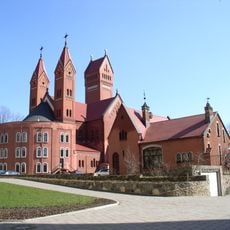
The bell stands on Independence Square beside the Red Church and the sculpture of Archangel Michael, with the granite slab and capsules set at its base. A rope hangs from the bell, and pulling it rings the bell. The square is a central transit point in Minsk, so the monument is passed on foot rather than visited by car.
The bell weighs 150 kg and bears the emblem of Nagasaki's Catholic cathedral. A delegation of 62 religious and lay people came from Japan for the consecration and the burial of the soil capsules. The granite slab carries a text in Belarusian and Japanese, and a cord hangs from the bell so anyone can ring it.
The community of curious travelers
AroundUs brings together thousands of curated places, local tips, and hidden gems, enriched daily by 94,232 contributors worldwide.