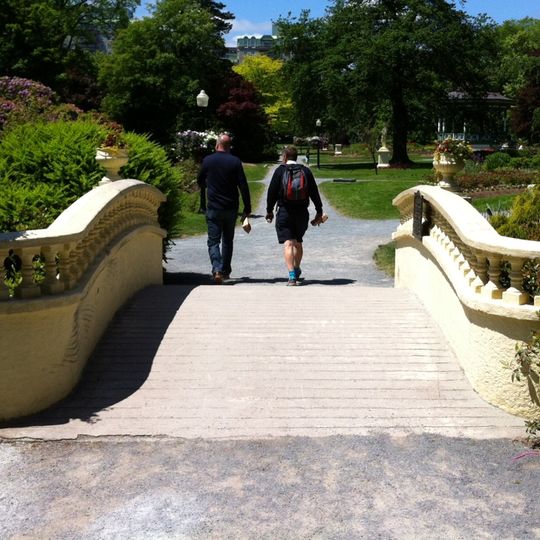
Halifax Public Gardens, Victorian garden in Halifax, Canada
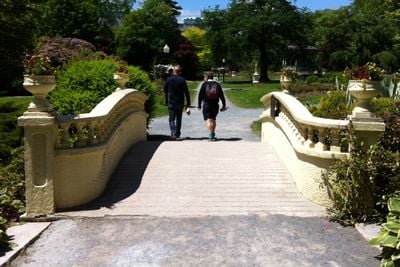
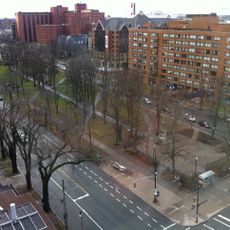
The Halifax Public Gardens cover 16 acres (6.5 hectares) on the Halifax Peninsula, bounded by Spring Garden Road, South Park Street, Summer Street and Sackville Street. Superintendent Richard Power's axially symmetrical plan organizes the Victorian formal layout, with three fountains, two stone bridges, three ponds, a bandstand designed by architect Henry Busch, and carpet beds of annuals.
The gardens were formally established in 1867, the year of Canadian Confederation, by merging the Nova Scotia Horticultural Society Garden, laid out in 1837, with an adjacent public park opened in 1866. In 1872 superintendent Richard Power introduced the axially symmetrical plan that still governs the layout. The site was designated a National Historic Site in 1984 and a Municipally Registered Property in 1991.
The bandstand, designed by architect Henry Busch and built in 1887, hosts free public concerts on Sunday afternoons in summer. The gardens also hold celebrations each year on Canada Day (July 1) and Natal Day, the first Monday in August. Six urns from the estate of Chief Justice Sir William Young were placed around the bandstand in its floating beds in 1887.
The gardens are open year-round, conditions permitting, and are bounded by Spring Garden Road, South Park Street, Summer Street and Sackville Street. The bandstand hosts free public concerts on Sunday afternoons in summer. Feeding the ducks is prohibited.
Griffin Pond, one of the three ponds, carries a model of the Titanic and is named after Lawrence Griffin, an Irishman hanged beside it on 24 October 1821 after a seven-month trial under Lt. Governor James Kempt, a conviction now considered wrongful.
The community of curious travelers
AroundUs brings together thousands of curated places, local tips, and hidden gems, enriched daily by 93,074 contributors worldwide.