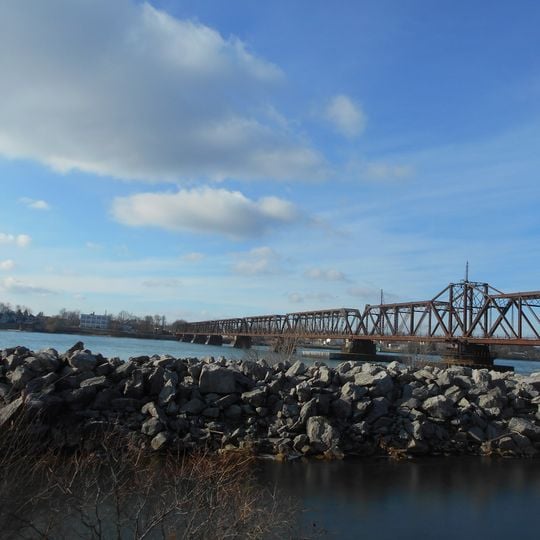
International Railway Bridge, Railway bridge on Niagara River between Fort Erie and Buffalo, United States and Canada
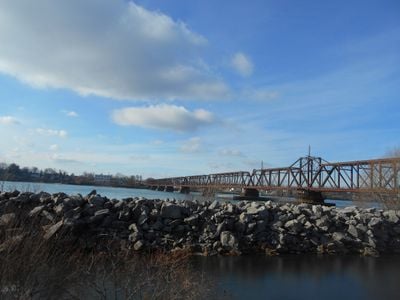
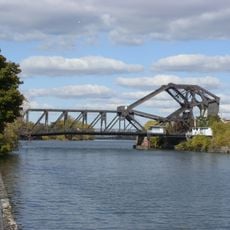
The International Railway Bridge carries freight trains across the Niagara River between Fort Erie, Ontario and Buffalo, New York using a steel truss structure. Two movable spans in the middle allow river traffic to pass through.
Built for the International Bridge Company by Casimir Stanislaus Gzowski and D.L. MacPherson, the bridge opened on 3 November 1873, nearly two years late, at a cost of $1.5 million and without a single fatality. Its eight stone piers were set after up to ten feet of river gravel was dredged away, and each was pointed and sloped upstream to break the spring ice. The 12 Pratt truss spans, made of iron from Phoenixville, Pennsylvania, were floated into place on pontoons that were then flooded to lower them onto the piers.
The bridge's name comes from the International Bridge Company, formed in 1870 when American and Canadian firms merged to build the crossing. Its busiest day was July 10, 1916, when 264 trains crossed. The swing span between Unity Island and the American mainland still opens for river traffic and carries a road and a bicycle lane.
The bridge is a working freight line of the Canadian National Railway's Stamford Subdivision, so it cannot be walked. The span between Unity Island and the Buffalo mainland still swings open for river traffic and carries a road on one side and a bicycle lane on the other, crossing over Interstate 190. The longer Canadian section is single track.
The bridge's busiest day was July 10, 1916, when 264 trains crossed. In 1903 baseball Hall of Famer "Big" Ed Delahanty, 35, died trying to cross after being put off a passenger train. The swing span over Black Rock Harbor still opens today.
The community of curious travelers
AroundUs brings together thousands of curated places, local tips, and hidden gems, enriched daily by 92,892 contributors worldwide.