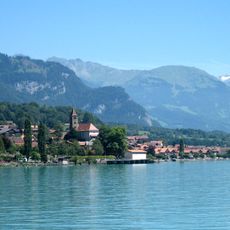
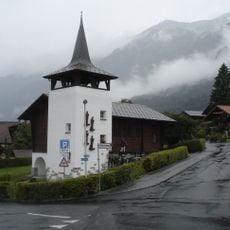
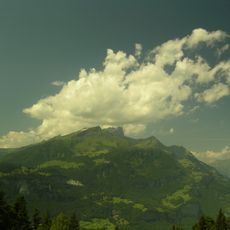
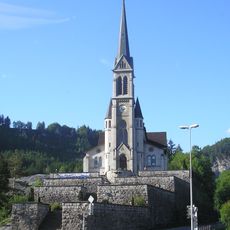
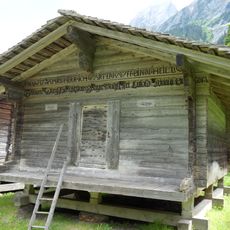
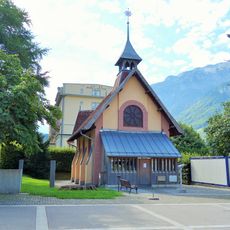
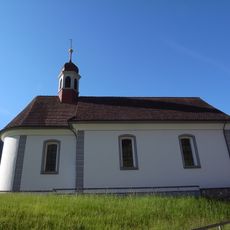
Brünig Pass, Mountain pass between Bernese Oberland and Central Switzerland.
Brünig Pass is a 1,008 m crossing between Meiringen in the canton of Bern and Lungern in Obwalden, on the watershed between the Aare and the Sarner Aa. A road (A8) and the narrow-gauge Brünig railway line, with rack sections, cross it; the Brünig-Hasliberg station stands about 100 m north of the summit at 1,002 m, and the tracks pass through a cutting at 1,001 m.
The pass lay on a route linking central Switzerland with the Grimsel and Gries passes toward present-day Domodossola, likely used since Roman times. In 1339 central Swiss warriors crossed it toward the Battle of Laupen, and in 1383 Lucerne, Schwyz and Uri troops crossed to support Bern at the siege of Burgdorf. Federal funds enabled a road, completed and inaugurated in 1861; before the Brünig railway opened in 1888, up to 120 private carriages and post wagons crossed.
The Brünig-Napf-Reuss line, a language and culture boundary within High Alemannic proposed in the mid-20th century and still debated, begins at the pass and runs north. Each year the Brünigschwinget, a Swiss wrestling competition of national prestige, is held here and counts among the six Bergkranz festivals.
The pass is accessible by both train and car throughout the year, with regular rail services connecting Lucerne and Interlaken. The Brünig-Hasliberg railway station offers convenient access for those using public transport.
The Brünig Pass appears in a watercolour by J. M. W. Turner, "The Brunig Pass, from Meiringen", painted around 1847–48. The pass also marks the start of the Brünig-Napf-Reuss line, a language and culture boundary within the High Alemannic area proposed in the mid-20th century and still debated today.
The community of curious travelers
AroundUs brings together thousands of curated places, local tips, and hidden gems, enriched daily by 92,787 contributors worldwide.