Fridolin bridge, Road bridge of prestressed concrete between Bad Säckingen, Germany and Stein, Switzerland
The Fridolin Bridge is a 244 m prestressed concrete road bridge crossing the Rhine at about 82° between Bad Säckingen and Stein, with two lanes and footpaths on both sides. Its three spans measure 106 m, 85 m and 53 m, and the 12.92 m wide deck is a single-cell box girder with varying depth. The roughly 16 m high piers are founded flat on rock.
A state treaty between Switzerland and West Germany, signed on 6 December 1976, provided for the new crossing to relieve Bad Säckingen's old town and the old wooden bridge. The canton of Aargau led planning and construction, which began on 1 March 1977; the bridge opened to traffic on 22 September 1979.
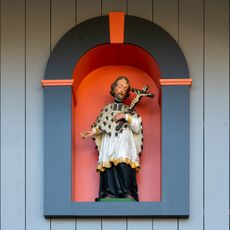
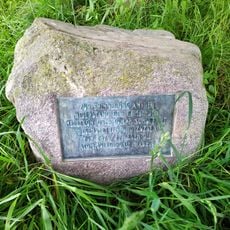
The bridge is named after Fridolin von Säckingen, the saint who founded the monastery of Säckingen. At its midpoint on the north side stands a bronze sculpture by Swiss artist Rolf Brem, cast in 1979, on a concrete base. A bronze band around the base reads: St. Fridolin Gründer von Säckingen und Patron der Landschaft am Hochrhein.
The bridge carries two traffic lanes and footways on both sides; the German side is part of Bundesstraße 518. The roadway is straight and slopes 2.4% toward Stein, and about 100 m before the Swiss abutment it widens into a trumpet shape for a turning lane at the junction with Hauptstrasse 7. The border runs down the middle of the Rhine with no marking on the bridge, and Swiss and German border checks share one office on German territory.
At mid-span on the north side stands a bronze sculpture by Swiss artist Rolf Brem, cast in 1979, on a concrete plinth. A bronze band around the block reads: St. Fridolin Gründer von Säckingen und Patron der Landschaft am Hochrhein. No line marks the border, which runs down the middle of the Rhine.
The community of curious travelers
AroundUs brings together thousands of curated places, local tips, and hidden gems, enriched daily by 92,793 contributors worldwide.