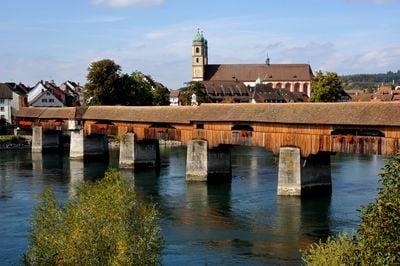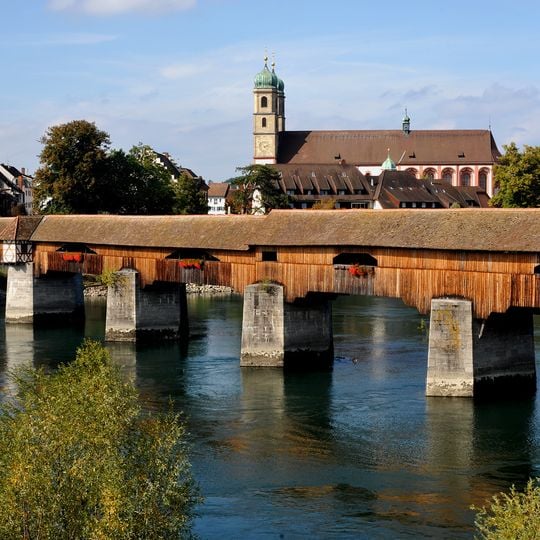
Holzbrücke Bad Säckingen, Wooden covered footbridge in Bad Säckingen, Germany and Stein, Switzerland.
Holzbrücke Bad Säckingen is a covered wooden footbridge on an S-shaped plan, 203.7 metres long (206.5 with the end canopies), crossing the Rhine between Bad Säckingen and Stein. Its seven openings rest on stone-clad concrete piers, four of them visible in the river, and the deck is carried by timber trusses under a shingled pitched roof. About 520 m³ of oak and spruce went into the 3.4 to 5.0 metre wide structure.
First mentioned in the Colmar annals of 1272, when it stood on twelve wooden piers. Floods and wars destroyed it repeatedly: a rebuild lasted from 1570 to 1590, French troops wrecked it in 1678, and the present structure was rebuilt in 1699. In 1801 the Hochrhein became the state border, and in 1979 the bridge passed back to Bad Säckingen.
The bridge is known in German as Holzbrücke and in Swiss usage as Säckingerbrücke. A bridge chapel was installed during the rebuilding of 1570 to 1590, after Rhine floods forced the longest reconstruction phase in its history. Since 1979 the crossing has served only cyclists and pedestrians, the road traffic having moved to the Fridolinsbrücke.
The bridge is for pedestrians and cyclists only; motor traffic crosses on the Fridolinsbrücke west of it, opened in 1979. The state border runs through the middle of the span, marked since 2023 by a historic boundary stone from 1810 at metre 110. The deck is 3.4 to 5.0 metres wide, so expect to share the covered passage with oncoming walkers and bikes.
Until 2014 the stone piers of the bridge still held live demolition charges: the Swiss Army needed only to insert detonators to blow it up in case of defence. The charges, probably several hundred kilograms of TNT, were found during restoration work and removed.
The community of curious travelers
AroundUs brings together thousands of curated places, local tips, and hidden gems, enriched daily by 92,783 contributors worldwide.