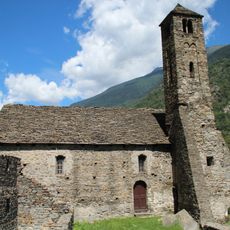
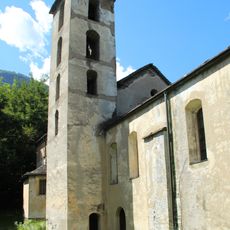
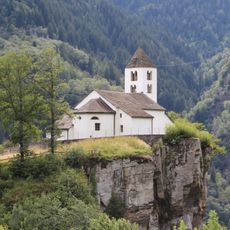
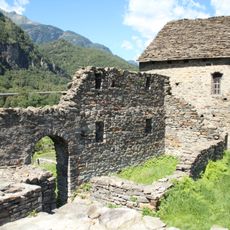
Chiesa di San Nicolao, Romanesque church in Giornico, Switzerland
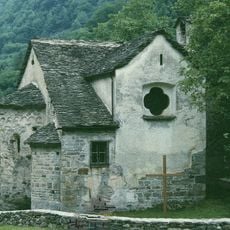
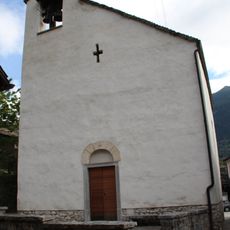
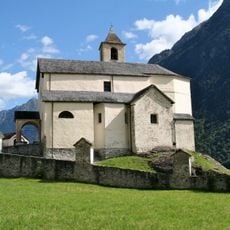
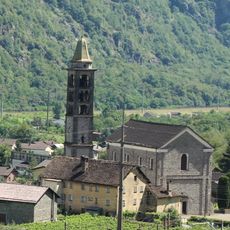
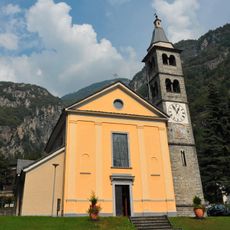
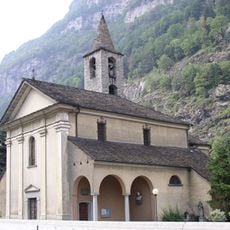
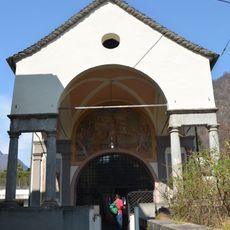
The Chiesa di San Nicolao is a single-nave Romanesque church outside Giornico, built of precisely cut local granite. Its gabled facade has two tall pilasters framing the main portal, carved capitals and two stylophoric lions, with a blind arcade running around the walls and apse. The raised square presbytery ends in a semicircular apse, and beneath it a hall crypt of three small naves is divided by eight columns with carved capitals.
A stone slab above the main portal bears the date 1168, possibly marking the end of construction or the consecration; the building may be linked to the planned opening of the Gotthard route. A parchment from the Chironico parish records the church as already built in 1202, with completion in 1210. In 1298 it is documented as belonging to the Benedictine abbey of Fruttuaria near Turin, and it likely served a now-vanished adjoining convent.
The apse is covered with frescoes dated 1478 and signed by Nicolao da Seregno, whose inscription above the central window reads "nicola seregnio de lug. pinsit"; the donors' names appear below. Christ in a mandorla is flanked by the four Evangelist symbols, and above the window a Trivultus — one face with four eyes, three noses and three mouths — was banned by papal edict in 1628 but never painted over, since San Nicola was never a parish church.
The church stands outside Giornico among the vineyards on the right bank of the Ticino, not in the village centre, so it is reached on foot from the village. The floor is laid with irregular granite slabs and the crypt is entered by descending a few steps, so footing is uneven. The site is a national monument and not a parish church, so it is not kept open at fixed parish hours.
The church was never a parish church, so the Trivultus in the apse — a face with four eyes, three noses and three mouths — was never painted over after a 1628 papal edict banned the image. The baptismal font, a 12th-century hexagonal basin carved from a single block, long stood in the neighbouring parish church of San Michele and later served as a fountain and flower basin before being moved here.
The community of curious travelers
AroundUs brings together thousands of curated places, local tips, and hidden gems, enriched daily by 94,165 contributors worldwide.