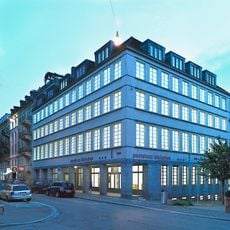
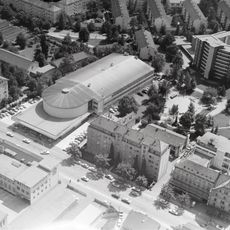
Bullingerkirche, Reformed church building in Hard, Zurich, Switzerland.
Bullingerkirche is a Reformed church on Bullingerplatz in Zurich's Hard quarter, built 1953–1956 by Hans and Kurt Pfister between the retained side wings of the 1925 complex. Its plan is a squat cross with bevelled walls; the windowless main facade is divided only by visible pillars, and a free-standing concrete campanile holds five bells cast in 1956 by H. Rüetschi of Aarau.
The Hard district got its first church in 1925, built by Karl Kündig and Heinrich Oetiker as one of Switzerland's first church centres, with a palace-like facade of two corner projections. A second parsonage followed in 1930. The present church replaced that building between 1953 and 1956, designed by Hans Pfister and Kurt Pfister, keeping the side wings. From 2023 to 2027 it serves as the provisional seat of the cantonal and city parliaments.
The name refers to Heinrich Bullinger (1504–1575), the reformer and theologian, stressing Zurich's role as a city of reformers. Some 200 metres away stands the Catholic church St. Felix and Regula, dedicated to the city's patron saints whose relics it keeps, so the two neighbouring churches set the Protestant and Catholic strands of Zurich's history side by side.
The church stands at Bullingerplatz in the Hard quarter, with the Kantonsrat and city parliament meeting inside from 2023 to 2027. During this time, Sunday services of the Bullinger congregation move to the former parsonage. The building was adapted for accessibility, and the changes are designed to be reversible after the parliaments leave.
The clock faces on the free-standing concrete campanile were decorated by artist Olga Titus as part of a "Kunst am Bau" project; their iridescent surface shifts colour and brightness with the sun's angle. The five bells, cast in light-ribbed steel by H. Rüetschi of Aarau, were hoisted into the tower in 1956.
The community of curious travelers
AroundUs brings together thousands of curated places, local tips, and hidden gems, enriched daily by 94,363 contributors worldwide.