Taku Forts, Military fortress in Tanggu District, China
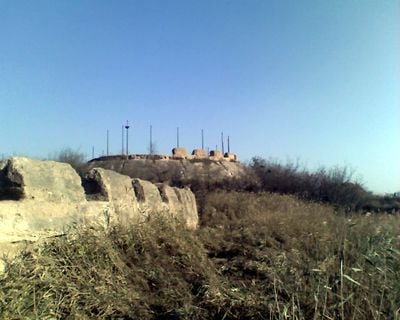
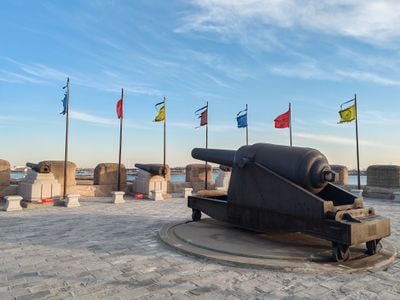
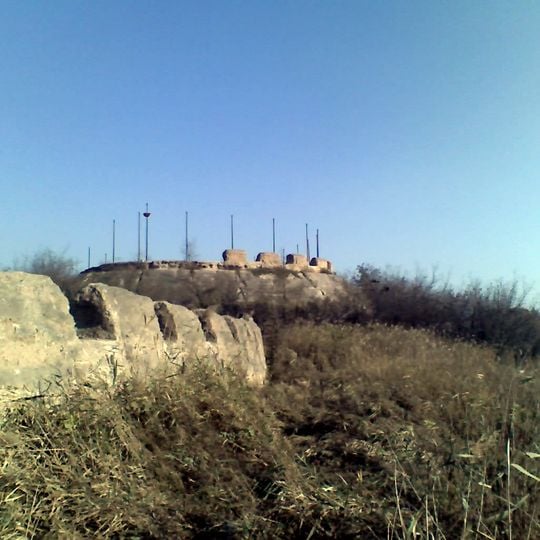
The Taku Forts are the two surviving forts of the Hai River estuary defences, the former "Wei" fort on the south bank and the former "Hai" fort on the north bank. The south-bank fort, repaired in 1988, shows a low wall of large pale stone blocks topped by an earthen rampart, with thin poles and small brick blocks along its edge. Cannons have been placed in reconstructed gun embrasures, and an exhibition in Chinese recounts the Opium Wars.
The first fort was built between 1522 and 1527 under the Ming Jiajing Emperor, supervised by Qi Jiguang, to guard Tianjin against wokou sea raiders. In 1816 the Qing built two forts on both banks of the Haihe estuary; by 1841 these had grown to five big forts, 13 earthen batteries and 13 earthworks. In 1851 Sengge Rinchen rebuilt six large forts, each with three large and 20 small guns.
The forts' names were auspicious words: Wei (Might) and Zhen (Thunder) on the south bank, Hai (Sea), Men (Gate) and Gao (High) on the north. The site is now a museum and heritage park, listed among the "Ten Views of Tianjin", with an exhibition recounting the Opium Wars and the forts' role.
The site is reachable by public transportation from central Tianjin with bus services stopping near the main entrance. Visitors should wear sturdy footwear as the grounds are uneven and include stairs climbing to different levels of the fortifications.
The two surviving forts are the former "Wei" (Might) fort on the south bank and the former "Hai" (Sea) fort on the north bank; the other four were dismantled after 1900 under the Boxer Protocol. Land reclamation has since left the south-bank fort well inland from the modern shoreline.
The community of curious travelers
AroundUs brings together thousands of curated places, local tips, and hidden gems, enriched daily by 92,815 contributors worldwide.