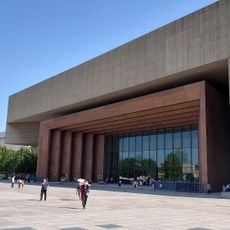
Jing-Jin-Ji, Capital region in North China.
Jing-Jin-Ji is an urban agglomeration of Beijing, Tianjin and Hebei Province along the Bohai Sea coast, covering an area about twice the size of South Korea. In 2020 it had a population of 110 million. Its 2025 GDP of CN¥12 trillion (US$1.7 trillion) is slightly larger than Turkey's.
The three areas entered a formal integration process beginning in 2014 to strengthen economic coordination. Since then, new transport routes and infrastructure have been built to increase cooperation between the previously separate territories.
The name Jing-Jin-Ji is built from the abbreviations Jing for Beijing, Jin for Tianjin and Ji for Hebei. The three parts were joined in planning documents from 1981, when the first territorial plan grouped Beijing, Tianjin and Tangshan around industrial and transport layout. Today the label covers 13 cities under the 2015 Outline Plan.
High-speed trains connect the major cities throughout the region, making travel between Beijing and Tianjin take about 30 minutes. Visitors can explore the entire area by public transportation, which operates regularly and is clearly marked.
The 2015 Outline Plan for Coordinated Development of Beijing-Tianjin-Hebei created Xiong'an, a new area meant to absorb Beijing's non-capital functions such as universities, research institutes and high-tech innovation centres. The 2016 rail plan approved by the central government covered nine railways totalling 1,100 km, with a long-term aim of a one-hour commuting region.
The community of curious travelers
AroundUs brings together thousands of curated places, local tips, and hidden gems, enriched daily by 93,908 contributors worldwide.