Gaochang, Archaeological site in Turpan Region, China.
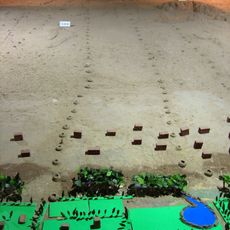
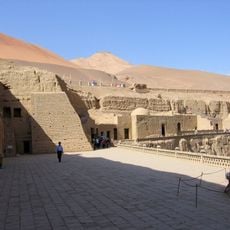
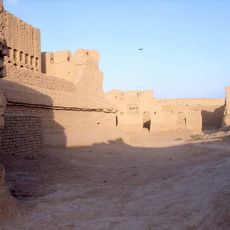
Gaochang is an ancient oasis city on the northern rim of the Taklamakan Desert in present-day Sanbu Township, Xinjiang, China. The ruins include an outer city, an inner city, and a palace city, covering about 2 million square meters with a perimeter of 5 kilometers. The walls are built of sandy-brown mud brick, with a tall rectangular block featuring vertical grooves and arched recesses, and triangular buttresses slanting against lower walls.
The city was founded as a military outpost in the first century BC and grew into an important trading hub. Over the centuries, it was gradually abandoned as trade routes shifted and regional control changed.
Gaochang's name comes from the Chinese for 'high and prosperous'. Men wore Hu-style dress while women dressed much like Chinese women, with skirts and buns. The state used Chinese characters alongside a local script, and students studied the Mao Shi, Analects and Classic of Filial Piety. In 629 the pilgrim Xuanzang was received by King Qu Wentai, and the city then held more than fifty monasteries.
The site lies in an arid climate and is best visited during cooler months when you can spend extended time outdoors. Comfortable shoes and sun protection are important, as there is little shade across the ruins.
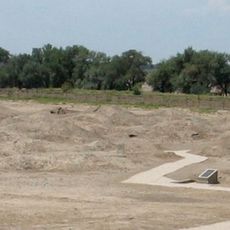
The two white signs at the base of the walls, marked E011 311 and E012 311, are modern survey markers placed by archaeologists. They identify the excavated sections of the mud-brick ruins, which were inscribed on the UNESCO World Heritage List in 2014 as part of the Silk Roads network.
The community of curious travelers
AroundUs brings together thousands of curated places, local tips, and hidden gems, enriched daily by 92,999 contributors worldwide.