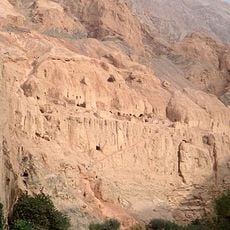
Bezeklik Thousand Buddha Caves, Buddhist grotto complex in Turpan, China
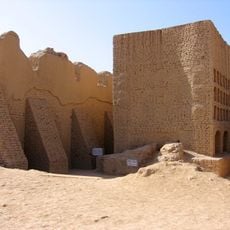
The Bezeklik Thousand Buddha Caves are 77 rock-cut caves set high on the cliffs of the west Mutou Valley in the Flaming Mountains. Most have rectangular rooms with round-arch ceilings divided into four sections, each painted with a Buddha, so the ceiling appears covered with hundreds of Buddha murals. Large "Praṇidhi Scene" paintings show Sakyamuni surrounded by Turks, Indians and Europeans.
The caves were cut and painted between the 5th and 14th centuries; most of those still standing date from the West Uyghur kingdom of the 10th to 13th centuries. The Buddhist Uyghurs of the Kingdom of Qocho and Turfan made the murals, and Sogdian donors appear in the praṇidhi scenes. Khizr Khoja (r. 1389–1399) converted the region to Islam by conquest, after which the caves were damaged and their statues destroyed.
The name Bezeklik comes from the Uyghur word for 'decorated'. The murals show Sogdian donors in silk robes, as in Scene 6 of Temple 9, and the paintings draw mainly on Chinese and Iranian styles, especially Sasanian Persian landscape painting. Albert von Le Coq noted a green-eyed figure in Scene 14 of Temple 9 wearing a green fur-trimmed coat and a hat like Sasanian princely headgear.
The caves sit outside the city center and require organized transport to reach comfortably. Wear good walking shoes, as the paths include stairs and uneven ground.
Albert von Le Coq, who first studied the murals and published in 1913, sent the best-preserved pieces to Berlin, where large Praṇidhi scenes were fixed to museum walls. They could not be moved during the Second World War and were destroyed in the Allied bombing of Berlin. Other pieces reached the Hermitage, the British Museum, the Tokyo National Museum and the national museums of Korea and India.
The community of curious travelers
AroundUs brings together thousands of curated places, local tips, and hidden gems, enriched daily by 94,087 contributors worldwide.