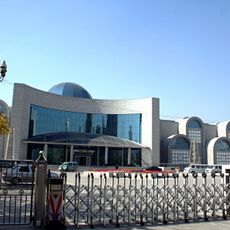
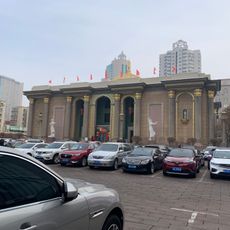
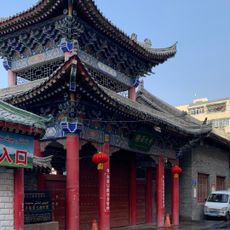
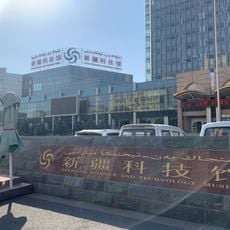
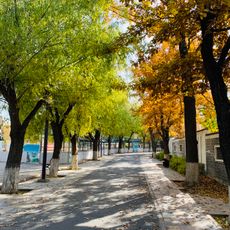
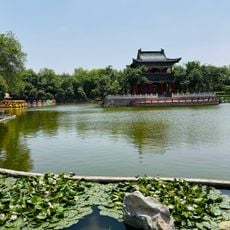
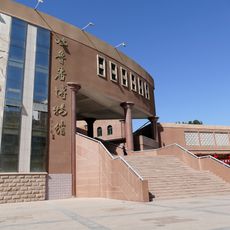
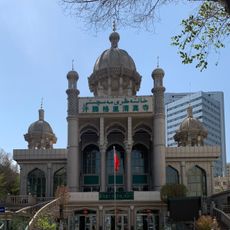
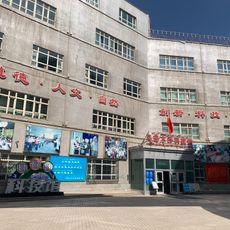
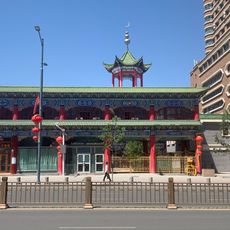
Urumqi Confucius Temple, Confucian temple in Tianshan District, Ürümqi, China.
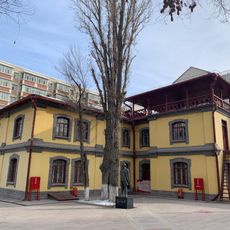
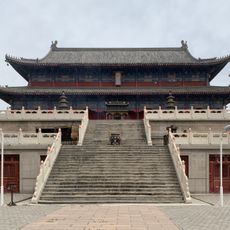
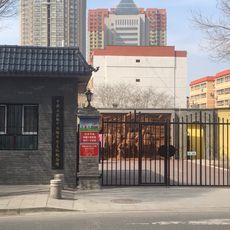
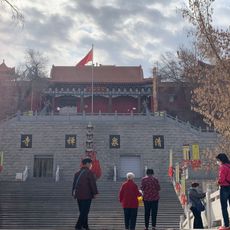
The Urumqi Confucius Temple is a two-courtyard complex of about 2,800 square meters at No. 15 on the north side of Qianjin Road. Its central axis runs from the main gate, over 13 meters wide, past the Guandi Hall with 28 red columns, to the Dacheng Hall, which has 30 red columns and a 0.8-meter base. The bell tower stands east and the drum tower west.
A Confucian temple and school were first planned in Dihua in 1769, and the temple was established east of Dongguanxiang Street in 1773. After the Dungan Revolt destroyed most such buildings in 1864, Zhou Chongfu built a new temple on Chengxi Street in 1879, rebuilt on a larger scale in 1890. In 1922 Yang Zengxin moved it to Xinmancheng East Street and renamed it "God Temple"; it became a warehouse in 1933 and was restored as a Confucius temple in 1945.
The temple hosts ceremonies honoring Confucius and functions as a place where people study Chinese philosophy and classical texts. Visitors can see how these intellectual traditions continue to shape how people think about learning and conduct in daily life.
You can reach this temple by entering through the adjacent Urumqi City Museum, which oversees the site. Planning your visit to include both locations makes sense since they operate together.
This is the only surviving temple of its kind from the Qing dynasty in the entire Xinjiang region, making it a rare example of this type of architecture outside China's main cultural centers. The preservation of this complex reflects how far Confucian education reached across different parts of the empire.
The community of curious travelers
AroundUs brings together thousands of curated places, local tips, and hidden gems, enriched daily by 93,148 contributors worldwide.