Primeval Structure Telescope, Radio telescope in Ulastai, China
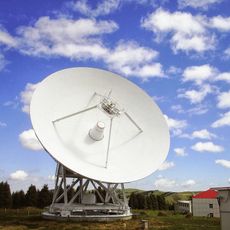
The Primeval Structure Telescope is a radio telescope in Xinjiang equipped with ten thousand log-periodic antennas positioned at 2500 meters elevation on the Ulastai plateau. The antenna array spans several kilometers and was specifically designed to observe hydrogen emissions from the early universe.
Construction began in 2004 under the National Astronomical Observatory of China to detect signals from the earliest luminous objects in the universe. This marked a major step forward in Chinese radio astronomy and research into the cosmic early universe.
The array is run by the National Astronomical Observatories of the Chinese Academy of Sciences and has been in service since 2007. Its name comes from the 21 cm spectral line of neutral hydrogen, the wavelength it was built to detect. The site lies near the Urumqi VLBI station in Gangou township, and the surrounding Ulastai plateau is kept free of television and radio transmitters.
The array sits on the Ulasitai plateau near the southern entrance of the Tianshan Shengli tunnel, close to the Nanshan Observatory in Gangou township. It is a working instrument, not a visitor site, so there is no public access or tour; the antennas are viewed from outside. The remote setting keeps television and radio interference low, and the altitude calls for acclimatisation before any stay.
The array's 10,000 log-periodic antennas are read out by just 20 off-the-shelf interferometers, and at 100 MHz the telescope covers a patch of sky only 3 arcminutes across. Its collecting area totals 70,000 m², giving a sensitivity of 1 millikelvin per day and an angular resolution of 4 arcminutes.
The community of curious travelers
AroundUs brings together thousands of curated places, local tips, and hidden gems, enriched daily by 94,410 contributors worldwide.