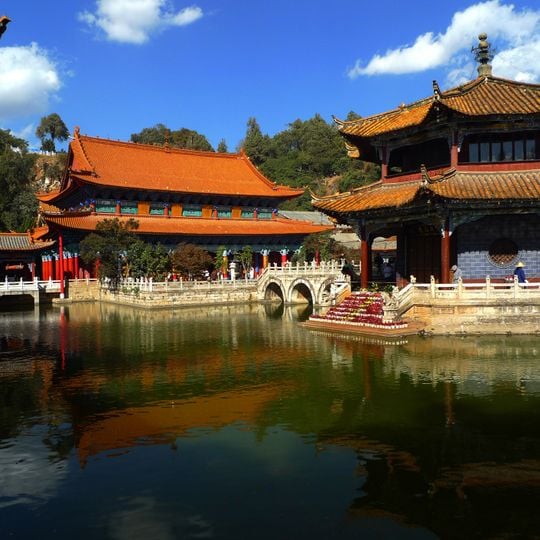
Yuantong Temple, Buddhist temple in Kunming, China
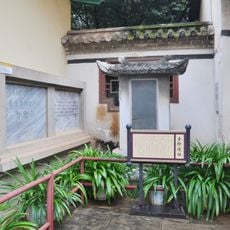
Yuantong Temple stands at the foot of Yuantong Hill in Kunming, covering 12,767 square metres. Its axis runs from the high south gate down to the lower main hall, passing the Yuantong Shengjing archway, the Dragon Flower Hall, an octagonal pavilion on a release-life pond linked by three-arch marble bridges, and the Yuantong Hall. Behind are cliff inscriptions and the Copper Buddha Hall.
Founded in the late 8th to early 9th century under the Nanzhao Kingdom, the temple was first named Butuoluo and served as a Guanyin shrine. It was destroyed in 1255 during the Mongol conquest, then rebuilt between 1301 and 1319 and renamed Yuantong. Ming and Qing restorations, notably under the Kangxi Emperor in 1668, gave it its present layout.
The temple's name, "Yuantong", is one of the Chinese names for Guanyin, and the site began as a shrine to that bodhisattva. Its halls now serve three traditions at once: Mahayana in the main Yuantong Hall, Theravada in the Thai-style Copper Buddha Hall, and Tibetan Buddhism in the Puguangming Hall, which holds a Vairocana image flanked by Padmasambhava and Tsongkhapa.
The grounds are accessible daily and offer plenty of space to explore the various halls and gardens. Visitors should wear comfortable shoes, as the site features stairs, bridges, and uneven pathways.
Behind the main hall, two caves, Yougu and Chaoying, wind into the mountain; local legend says dragons once lived there, and in the Nanzhao Kingdom a monk built a cliffside temple to lure them. Sun Ranweng, author of the long couplet at Daguan Belvedere, earned a living telling fortunes here.
The community of curious travelers
AroundUs brings together thousands of curated places, local tips, and hidden gems, enriched daily by 92,783 contributors worldwide.