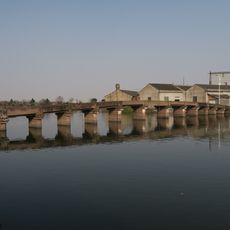
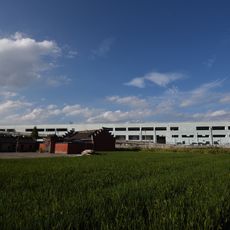
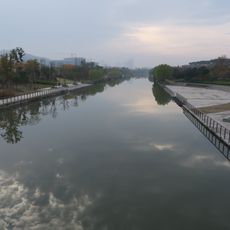
Tianluoshan Site, Archaeological site in Sanqishi Town, China
Tianluoshan is a Hemudu Culture site covering about 30,000 square metres, with six cultural layers dated to roughly 7000–5500 years ago. Excavations from 2004 revealed rows of pile-dwelling foundations and a fairly complete village layout. The site is known as the "second Hemudu" because its above-ground setting and underground remains are unusually well preserved.
Discovered in 2001 when a heat-treatment factory struck pottery, animal bones and wood while drilling a well, Tianluoshan was excavated from February to June 2004. The finds matched those of Hemudu and revealed a village layout with rows of pile dwellings across six cultural layers, dated to about 7000–5500 years ago.
The site lends its name to the Tianluoshan Site Museum, opened in 2007 at the excavation area, where finds are displayed alongside the exposed pits. Among the pottery are a face-shaped vessel support and an elephant-head figurine not found at Hemudu itself. A carbon-tempered jar with two handles and a deep belly stands nearly 70 cm tall, the first of its size in Zhejiang.
The site is located north of another significant archaeological location in the region. Visitors should be aware that this is an excavated site where structures are often partially below ground level.
In 2004, twelve roots of tea shrubs (Camellia sinensis) were found at Tianluoshan, dated to about 5450 BCE. Together with壶-shaped pottery, they suggest people may already have grown and drunk tea. The site also yielded a carbon-tempered jar with two handles and a deep belly nearly 70 cm tall, the first of its kind in Zhejiang.
The community of curious travelers
AroundUs brings together thousands of curated places, local tips, and hidden gems, enriched daily by 93,086 contributors worldwide.