Church of the Mother of God, Catholic church in Macau, China
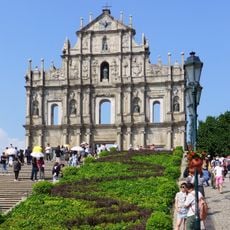
The Church of the Mother of God, also called the Church of Saint Paul, survives only as the granite facade and 68-step staircase of the Ruins of Saint Paul. The facade, 23 metres wide and 25.5 metres high, has five horizontal levels crowned by a triangular pediment. It was carved between 1620 and 1627 by Japanese Christian exiles and local artists under the Jesuit Carlo Spinola.
The Jesuits built the church in 1565 beside the College of São Paulo, the first Western-style university in the East. A fire damaged it in 1595, and repairs were completed in 1602, when it reopened. The Jesuits were expelled in 1762, and in 1835 a fire that began in the college kitchens destroyed both buildings, leaving only the granite facade and the 68-step stairway.
The facade mixes Chinese, Japanese, Portuguese and Christian motifs: a Chinese lion, Japanese chrysanthemums, a Portuguese caravel and statues of four Jesuit saints. A Chinese inscription calls Mary "the Holy Mother who treads on the dragon's head". Visitors throw coins from the upper window of the ruins, a gesture held to bring good luck.
Only the granite facade and the 68-step stair survive; a steel staircase behind the facade lets visitors climb for a close view. It is customary to toss coins from the upper window for good luck. The crypt and foundations, unearthed in excavations from 1990 to 1995, are displayed in a museum on the site.
The facade was carved between 1620 and 1627 by Japanese Christian exiles and local artists under the Jesuit Carlo Spinola, and mixes Chinese lions, Japanese chrysanthemums and a Portuguese caravel. Visitors often throw coins from the upper window, a gesture held to bring good luck.
The community of curious travelers
AroundUs brings together thousands of curated places, local tips, and hidden gems, enriched daily by 93,087 contributors worldwide.