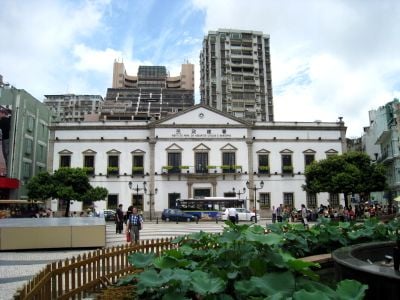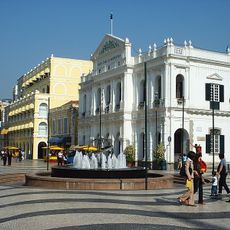
Leal Senado Building, Municipal affairs bureau in a neoclassical building in São Lourenço, Macau, China
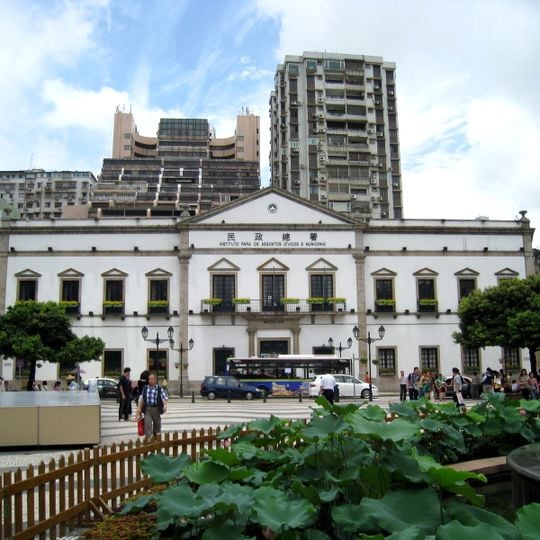
The Leal Senado Building is a two-storey neoclassical building on the Senado Square, with a symmetrical white facade topped by a triangular pediment bearing Chinese characters and the Latin inscription "INSTITUTO PARA OS ASSUNTOS CIVICOS E MUNICIPAIS". Three arched openings with keystones and six rectangular windows with dark shutters and small balcony railings flank the ground floor, while the upper floor has five windows. Inside, the building is U-shaped with three depths: a central entrance hall, an administrative area with a grand hall, and a Portuguese garden at the rear.
A Chinese pavilion stood on this site, where Ming officials announced regulations to Macau's Portuguese and Chinese residents. Portugal bought the plot in 1784 for 80,000 taels and built the senate house, which became the seat of Macau's government. Prince regent João, later King John VI, granted the title Leal Senado in 1810 for Macau's loyalty during the 1580–1640 Spanish rule of Portugal; his plaque hangs in the entrance hall. The building was refurbished in 1904 and damaged by a typhoon in 1936.
The building houses a library modeled after Portugal's Mafra Convent, containing foreign language books collected over several centuries. This collection reflects the city's deep connection to overseas trade routes and cultural exchange with distant lands.
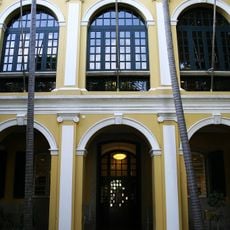
The building stands at 163 Avenida de Almeida Ribeiro, at the northern end of Senado Square, and is entered from the square through the central arched doorway. The courtyard garden at the rear, reached through arched openings past the stair hall, is open to visitors and holds the armillary-sphere flowerbed and fountain. The upper-floor library and the gallery off the entrance hall are the interior spaces to seek out.
The wooden half-moon plaque above the arched stairway in the entrance hall carries the Latin motto "Cidade do Nome de Deus, não há outra mais leal" — City of the Name of God, there is no other more loyal. It recalls the title King John IV granted Macau for refusing to recognise Spanish rule during the Philippine Dynasty, 1580–1640.
The community of curious travelers
AroundUs brings together thousands of curated places, local tips, and hidden gems, enriched daily by 92,785 contributors worldwide.