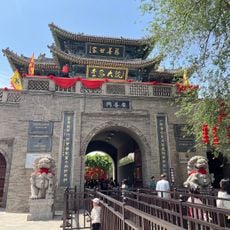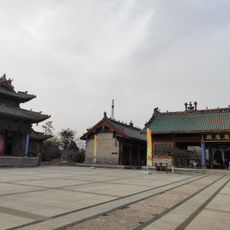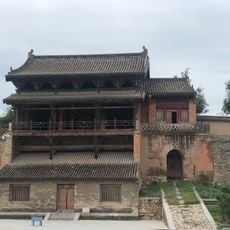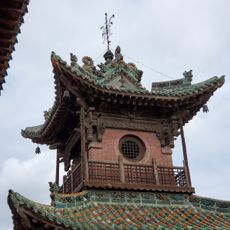
Temple of Yu the Great, National temple complex in Hancheng, China.
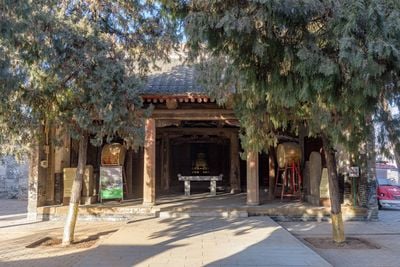
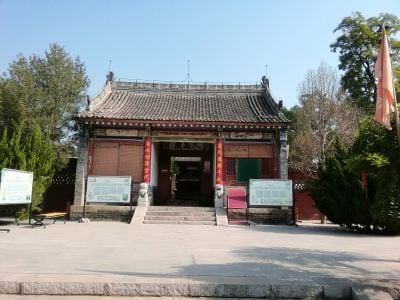
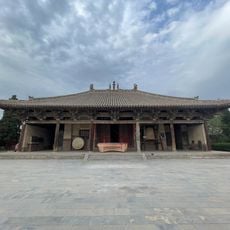
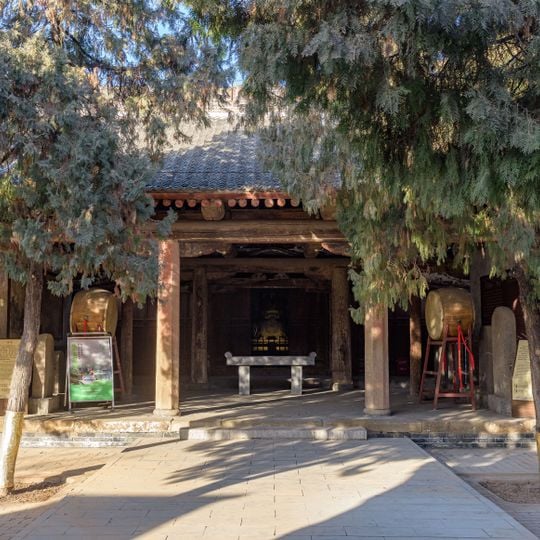
The Temple of Yu the Great in Zhouyuan Village, Hancheng, preserves two main halls: an offering hall 10.3 m wide and 6 m deep with a single-eaved yingshan roof, and a main hall of three bays, 11.2 m wide and 6.8 m deep, under a single-eaved xianshan roof. Inside the main hall are Qing-dynasty murals and wooden plaques, plus painted clay statues of Yu the Great and Guo Ziyi. The photograph shows weathered wooden columns, carved brackets and two large drums flanking the open central bay.
The original structure was built in 1301 during the Yuan Dynasty as a place to honor Da Yu. Major reconstruction took place in 1579 during the Ming Dynasty, which shaped the complex into its present form.
The temple is dedicated to Yu the Great, the legendary ruler credited with controlling the floods. Inside the main hall are painted clay statues of Yu and of Guo Ziyi, a Tang general, alongside Qing-dynasty murals and a wooden plaque. A large drum on a frame stands to the left of the open central bay, with a sign beneath it, and a second drum on the right.
The temple stands east of Zhouyuan Village, on Xincheng Subdistrict in Hancheng, Weinan, Shaanxi. The surviving structures are the offering hall, 10.3 m wide and 6 m deep, and the main hall, 11.2 m wide and 6.8 m deep. Look for the Qing-dynasty murals and wooden plaques inside the main hall.
The main hall holds Qing-dynasty murals and wooden plaques, along with painted clay statues of Yu the Great and Guo Ziyi, the Tang general. The presence of Guo Ziyi reflects local veneration beyond Yu alone. The temple was listed as a Major Historical and Cultural Site Protected at the National Level in 1996, under number 4-126.
The community of curious travelers
AroundUs brings together thousands of curated places, local tips, and hidden gems, enriched daily by 94,971 contributors worldwide.