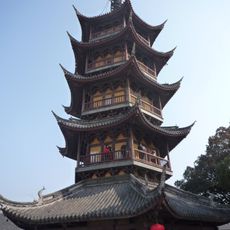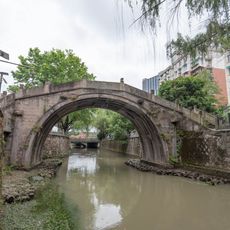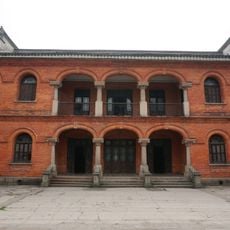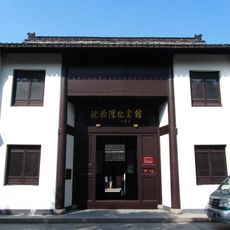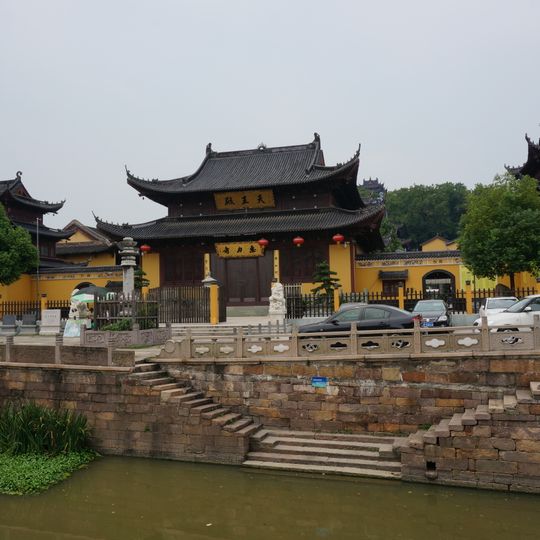
Huili Temple, Buddhist temple in Xishan Park, Haining, China
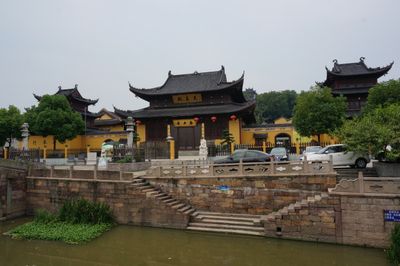
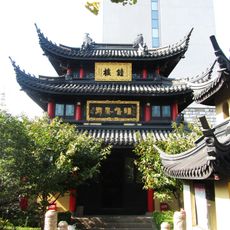
Huili Temple stands at the southern foot of Ziwei Hill in Xishan Park, Haining. Its Mahavira Hall, rebuilt in 1922, is five bays wide with a double-eave gable-and-hip roof; the central bays use post-and-lintel framing, the side bays post-and-tie framing, and the ridges carry modelled landscape scenes. In front of the hall stand two octagonal stone pillars, about 5 metres high, set on sumeru pedestals carved with coiled dragons.
An official named Zhang Yanguang gave up his residence to found Zhiyuan Temple between 373 and 375, in the Eastern Jin dynasty. In 1009, during the Song dynasty, the court granted it the name Huili Temple. The two stone pillars in front of the temple were erected in 874, the fifteenth year of the Xiantong era, and the east pillar carries a dedication inscription. The Mahavira Hall was rebuilt in 1922.
The temple is popularly called West Temple, Xisi, because of its position at the southern foot of Ziwei Hill, the Western Hill of Xiashi. The east pillar carries a dedicatory inscription recording its making in 874, while the sutra text on the shafts is in the calligraphy of Yu Zonghou. Look for the flying apsaras carved on the underside of the stone disc near the top.
The sanctuary sits within Xishan Park and is readily accessible to visitors interested in Buddhist history. Allow time to examine the fine details of the stone pillars closely and study the inscriptions carefully.
The stone pillars are remarkable for surviving nearly 1,000 years since the 9th century. Their designation as national historical monuments highlights the extraordinary importance of these ancient carved works.
The community of curious travelers
AroundUs brings together thousands of curated places, local tips, and hidden gems, enriched daily by 94,271 contributors worldwide.