Preußenmauer, Defensive wall in Heligoland, Germany.
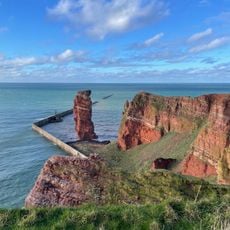
The Preußenmauer is a coastal fortification on Helgoland island built from solid stone in the early 20th century. The structure runs along the shoreline and displays the engineering techniques typical of that military construction period.
The Preußenmauer was built to shield Helgoland's western cliff from erosion, not as a defense network. Work began in 1910 at the south tip and reached Blockhörn in 1913; after a World War I interruption it resumed in 1926 and was finished in 1927. The name comes from the Prussian state taking over construction from the Reich military building administration in 1908. Repairs after World War II damage were carried out from 1960 to 1963.
The name comes from the Prussian state taking over the works from the Reich's military construction administration in 1908; the northern section had been built under imperial direction. The southern half, from the island's south tip to Blockhörn, was then built between 1910 and 1913. The protective wall at the Lange Anna was added later as part of the Hummerschere project.
The wall runs along Helgoland's southwest cliff edge, from the southern tip toward Blockhörn; the northern tip was never walled. Sections were repaired between 1960 and 1963 after wartime damage, so expect rebuilt stretches beside older masonry. The cliff-top path is exposed to North Sea wind and spray, so wear sturdy shoes and keep to marked paths.
The name comes from the Prussian state taking over the work in 1908, after the Reich's military construction administration had built the northern section. A test wall was already erected in 1903 at Blockhörn and Siderst Hörn before the main wall began at the southern tip in 1910.
The community of curious travelers
AroundUs brings together thousands of curated places, local tips, and hidden gems, enriched daily by 94,632 contributors worldwide.