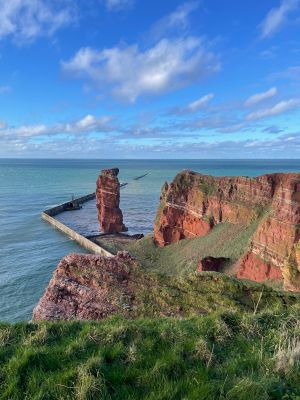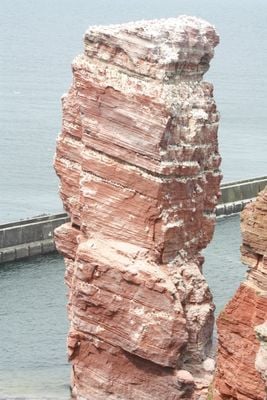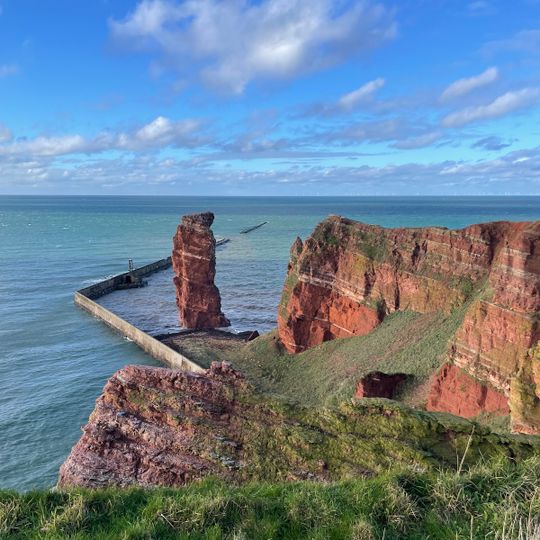
Lange Anna, Natural rock formation in Heligoland, Germany.
Lange Anna is a freestanding sea stack made of red sandstone that rises from the water off the northwest coast of Helgoland. The formation stands alone in the sea and displays the characteristic reddish rock layer found throughout the island.
The formation was originally connected to the main island by a natural arch until it collapsed in 1860. Since then, the structure has stood freely in the sea and continues to develop as an independent geological feature.
On Heligoland Frisian the stack is called Nathurn Stak, "northern stack". The German name Lange Anna arose around 1900 from pre-war popular humour, in the vein of nicknames like Dicke Berta; the tale of a tall waitress is a later explanation. Islanders long regarded the name as disrespectful.
A walking path along the cliff edge leads to several viewing points where you can observe the formation from different angles. The trail runs above the steep coastline and offers open views over the water throughout.
In 1979 a surf hollow at the foot of the stack was walled up to stabilise it, not filled with concrete. A 1998 study by TU Harburg found weathering too advanced for a concrete base or pressed-in cores, so the rock has since been left to natural decay.
The community of curious travelers
AroundUs brings together thousands of curated places, local tips, and hidden gems, enriched daily by 92,676 contributors worldwide.