Helgoländer Felssockel, Marine protected area near Heligoland, Germany
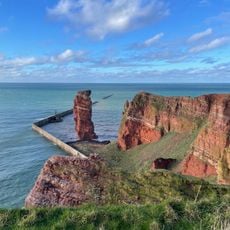
The Helgoländer Felssockel is a marine protected area in the North Sea around the islands of Heligoland and Düne, covering 5,138 hectares in two parts. Its seabed of rock and sand reaches depths of 48 metres and forms Germany's only marine hard-bottom biotope. In the north and west, the rock foreshore is exposed at low tide.
The area was designated a marine nature reserve on 24 April 1981 by regulation No. 91/1981 of Schleswig-Holstein. Since 1983 the Jordsand association has managed it. It forms part of the Natura 2000 site "Helgoland mit Helgoländer Felssockel" and lies almost entirely within the EU bird sanctuary DE-1813-491.
Since 1983 the Jordsand Association, a German society for the protection of seabirds and nature, has looked after the reserve. Its wardens work on the two islands and on the water, and the reserve also forms part of the EU bird sanctuary Seevogelschutzgebiet Helgoland, where seabird colonies of the Heligoland cliffs are counted and monitored.
The area is best explored by water, with boat trips offering views of the rocks and coastlines. Visitors can also observe the seabed and marine features from the cliffs during favorable conditions.
The seabed features distinct underwater environments including rocky areas with kelp growth and deep-dwelling creatures rarely found elsewhere in German waters. These rock formations create uncommon habitats that support specialized marine communities.
The community of curious travelers
AroundUs brings together thousands of curated places, local tips, and hidden gems, enriched daily by 93,876 contributors worldwide.