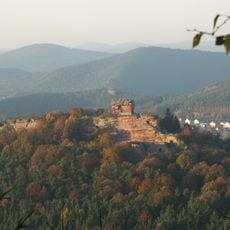
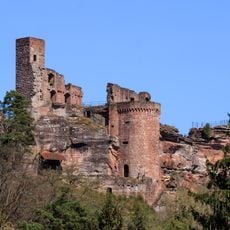
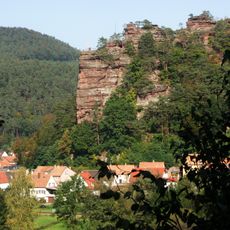
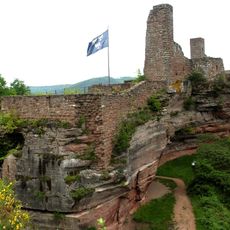
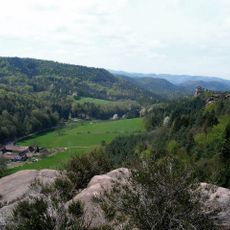
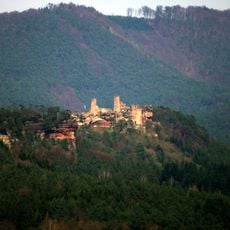
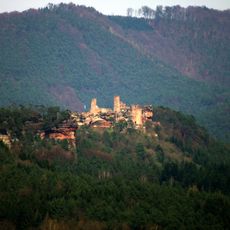
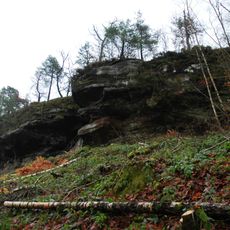
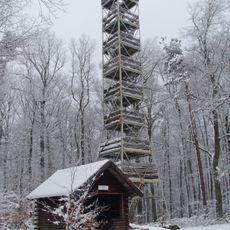
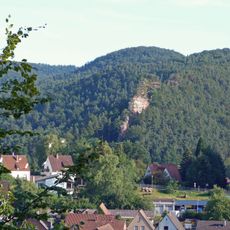
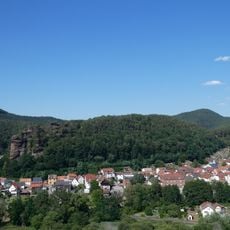
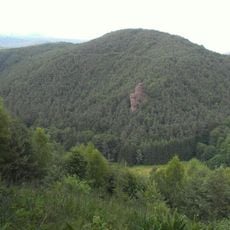
Castle Neudahn, Rock castle in Dahn, Germany.
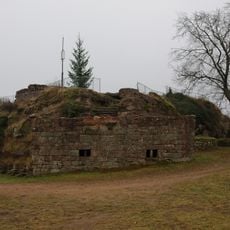
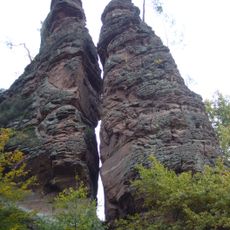
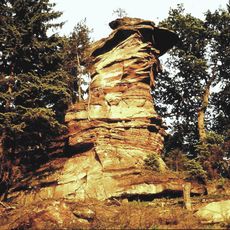
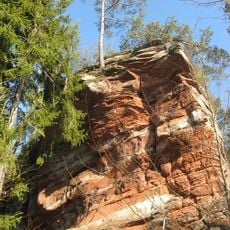
Neudahn Castle is a rock castle whose core stands on a roughly 20-metre-high hewn sandstone crag at the northern end of a ridge near Dahn. The ruins are dominated by two four-storey battery towers about 24 metres high, with walls around 3 metres thick, and include a wedge-shaped bastion on the east-southeast side.
The castle was probably built shortly before 1240 on the orders of the Bishop of Speyer, an office held from 1233 to 1236 by Conrad IV of Dahn. The ministerialis Henry of Dahn, also recorded as Henry Mursel of Kropsberg, likely held it from the outset as a heritable fief. It is first mentioned on 3 May 1285 as Burg Than. Probably razed in the Four Lords' War and rebuilt, it was badly damaged in the German Peasants' War of 1525, renovated before King Henry II of France stayed overnight in 1552, and finally destroyed by French troops in 1689.
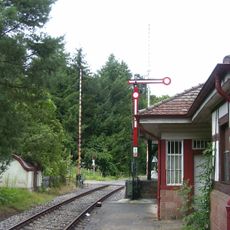
The name Neudahn ("New Dahn") is misleading: the castle is older than Grafendahn but younger than Altdahn. Its position let it guard and block the old road through the Wieslauter valley, where the B 427 and the Wieslauter Railway now run side by side.
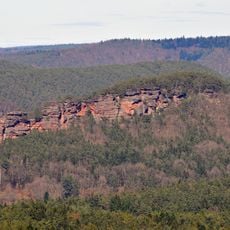
The ruins stand on a sandstone spur about 90 metres above the Wieslauter valley, 2 km northwest of Dahn. The main rock is reached by paths that are rocky and uneven near the top, so solid footwear helps. The site is managed by the Generaldirektion Kulturelles Erbe Rheinland-Pfalz.
The double gun tower from the 16th century was designed so that two cannons could fire side by side, which is unusual for a rock castle of this size. This solution shows how the builders worked around the natural rock formations rather than against them.
The community of curious travelers
AroundUs brings together thousands of curated places, local tips, and hidden gems, enriched daily by 94,633 contributors worldwide.