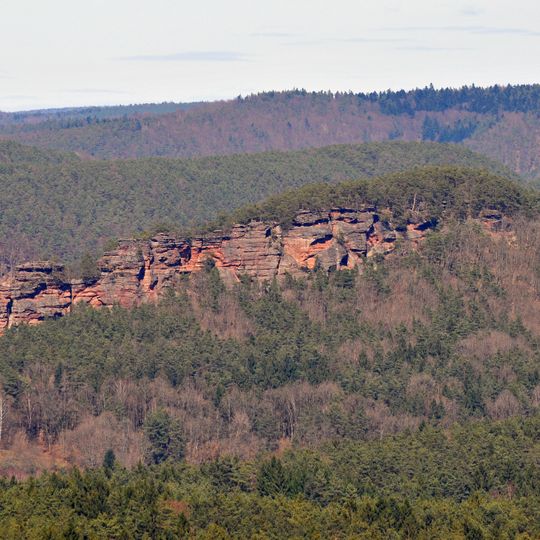
Hochstein, Rock formation and natural monument in the Dahner Felsenland, Rhineland-Palatinate, Germany
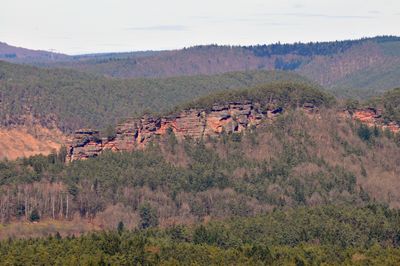
The Hochstein is a 345-metre-high rock group of layered bunter sandstone east of Dahn above the Wieslauter stream, stretching about 1.5 km and split into separate blocks. It begins in the west near St. Michael's Chapel with the Hochsteinnadel, followed by the Gratturm and the main Hochsteingrat ridge, with spurs running northeast and south, the Haferfels standing out. The crag shows grey weathered upper layers above reddish-orange stone, with trees and undergrowth on the slope below.
The Hochstein is a massif of bunter sandstone, a harder rock that partly withstood erosion, running 1.5 km east of Dahn above the Wieslauter. The Hochsteinnadel was first climbed in the 19th century by a man who jumped from the Gratturm onto the needle and fell to his death attempting to jump back; the first technically successful ascent was in 1908. Towards the end of the Second World War, Dahn families sheltered for long periods under overhanging rocks, and traces of these emergency dwellings are still visible.
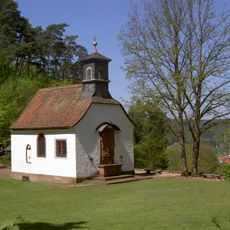
The massif begins in the west at the Hochsteinnadel, a needle of rock beside St. Michael's Chapel, and continues past the Gratturm to the main Hochsteingrat ridge. Climbers know the needle's first ascent: in the 19th century a climber jumped from the Gratturm onto it and fell to his death trying to jump back; the first technically successful ascent came in 1908.
The massif stretches 1.5 km east of Dahn above the Wieslauter stream, beginning at the Hochsteinnadel near St. Michael's Chapel and continuing past the Gratturm to the Hochsteingrat ridge. Climbers and walkers use the marked paths that link these sections. The rock face is layered gray and reddish-orange sandstone, with trees and undergrowth on the slope below.
The first ascent of the Hochsteinnadel took place in the 19th century, when a climber jumped from the Gratturm onto the needle; he fell to his death trying to jump back. The first technically successful climb followed in 1908. Near St. Michael's Chapel, the needle marks the western start of the massif.
The community of curious travelers
AroundUs brings together thousands of curated places, local tips, and hidden gems, enriched daily by 92,638 contributors worldwide.