Drachenfels Castle, Medieval rock castle in Busenberg, Germany.
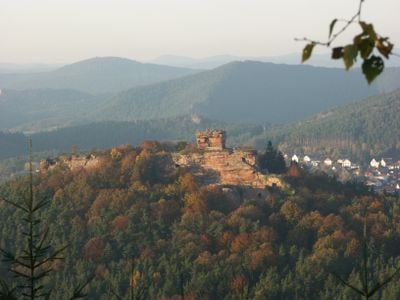
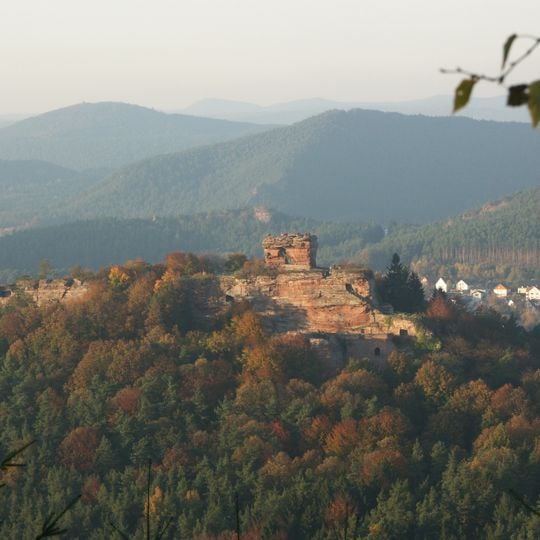
Drachenfels Castle sits on two steep sandstone cliffs at 367 meters elevation within the Palatinate Forest nature reserve. The structure divides into an upper and lower castle, with ruins visible in both sections.
The castle was first documented in 1245 with Walter of Drachenfels, though its origins remain unclear. In 1314 it was damaged during a Strasbourg campaign against Berwartstein, and after a 1335 feud with Strasbourg parts were sold off from 1344, creating a joint inheritance. In 1510 Franz von Sickingen acquired a share; after his defeat the castle was surrendered without a fight and destroyed on 10 May 1523, with rebuilding forbidden.
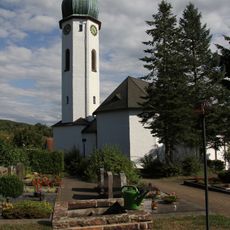
The castle's name may come from a dragon carved into the sandstone wall of the former great hall, though its date is unknown. From the early 14th century the lords' seal showed a deer's antler or a wild goose. In 1778 Franz Christoph Eckbrecht von Dürkheim built the Schlösschen in Busenberg with stones from the ruin, and the village church also used them.
A paved road from Busenberg leads to the Drachenfels hut, then a roughly 200-meter walk takes you to the entrance. The path is steep and calls for sturdy footwear and moderate fitness.
A dragon symbol was carved into the sandstone wall of the former knights' hall, which is where the fortress takes its name. This dragon motif continues to shape how people identify and remember this medieval site.
The community of curious travelers
AroundUs brings together thousands of curated places, local tips, and hidden gems, enriched daily by 94,060 contributors worldwide.