Lindelbrunn Castle, Medieval rock castle in Vorderweidenthal, Germany
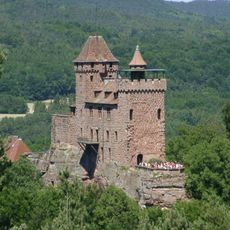
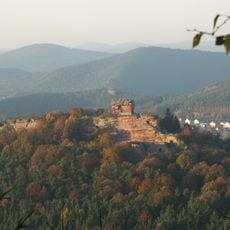
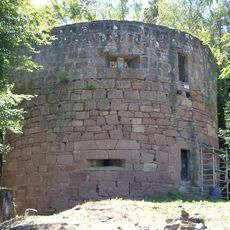
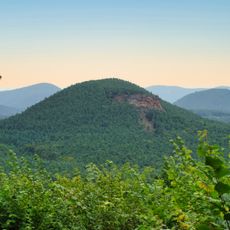
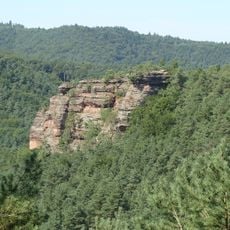
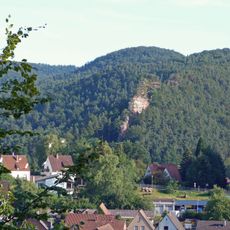
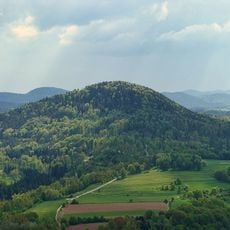
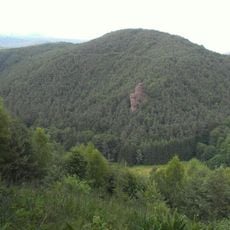
Lindelbrunn is a castle ruin on sandstone cliffs at roughly 438 meters in elevation, with remaining walls, a palas building, and chapel foundations visible across the site. The layout follows a typical medieval hilltop fortress design with distinct areas for living, defense, and worship.
Lindelbrunn Castle was founded in the mid-12th century, probably as an imperial castle defending the Trifels; it may previously have belonged to the imperial church of Speyer. In 1268 Dieter von Lindelbol, a descendant of the imperial seneschal Markward von Annweiler, is first documented. Around 1190/1200 the palas and a free-standing chapel were built, works reserved for high-ranking lords. In 1274 King Rudolf of Habsburg enfeoffed Counts Emich IV and Frederick III of Leiningen. In 1525 rebellious peasants of the Kleeburg Kolbenhaufen band burned it down.
The name probably comes from the castle well beneath a large lime tree (Linde). A legend tells of an old grey-haired woman who planted a lime branch by the well and said the knight's line would flourish as long as the tree bloomed; when the knight rejected his outcast brother Rothkopf, she drove a distaff into the tree and it fell into the well. St. Nicholas' Chapel is documented from 1381.
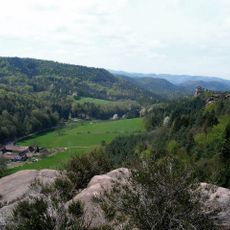
From the Forsthaus Lindelbrunn forester's lodge at the foot of the Schloßberg, the climb to the ruins takes 15 to 20 minutes on foot. The surviving inner gate lies in the northeast of the site; an older entrance south of it survives as a shaft hewn through the sandstone. In clear weather the summit gives a 360-degree view that reaches the Trifels.
The name comes from an old legend about a woman who planted a lime tree and declared the castle would thrive as long as the tree lived. This story ties the fortress to nature and shows how people once explained their world through such tales.
The community of curious travelers
AroundUs brings together thousands of curated places, local tips, and hidden gems, enriched daily by 93,367 contributors worldwide.