Berwartstein Castle, Medieval castle in Erlenbach bei Dahn, Germany
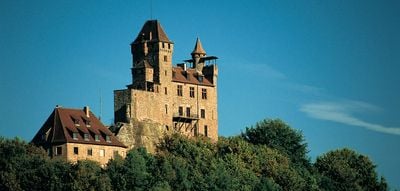
Berwartstein is a rock castle carved into a sandstone spur above Erlenbach bei Dahn. Its two joined sections rise from a rocky base: a taller block with a steep pyramidal roof and a lower square tower with a conical roof and short spire. The upper castle covers over 400 m², but most masonry dates from the 1890s reconstruction; the rock chambers, the knights' hall south wall and the 2 m wide well shaft are original.
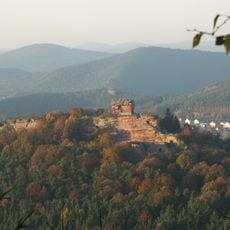
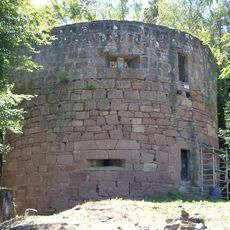
Berwartstein is first documented in 1152, when Emperor Frederick Barbarossa granted it to Bishop Günther of Speyer. In 1314 troops from Strasbourg and Haguenau took the castle after a siege and broke it; the Berwartstein family died out in 1345. In 1480 Elector Philip the Upright enfeoffed his marshal Hans von Trotha with the castle, and he added the outwork Klein-Frankreich in 1484. A fire, probably caused by lightning, destroyed it in 1591; it stood in ruins until Captain Bagienski bought it in 1893 and began rebuilding.
The castle shows how medieval inhabitants carved living and defensive spaces directly into the rock face. The rooms and passages built into the sandstone reveal practical construction methods from that era.
The castle is accessible only through guided tours, most offered in German, which take visitors through the various levels and chambers. Plan for uneven ground and steep steps, as the structure is carved into and built upon the rock.
The only medieval entrance was the Aufstiegskamin, a natural shaft on the southeast cliff. A portable wooden staircase or rope ladder was used and hoisted up during attacks, so one defender could pour boiling sap or oil on intruders. The narrow, almost vertical cliff rises about 45 metres.
The community of curious travelers
AroundUs brings together thousands of curated places, local tips, and hidden gems, enriched daily by 93,850 contributors worldwide.