Alte Pinakothek, State art museum in Kunstareal, Germany.
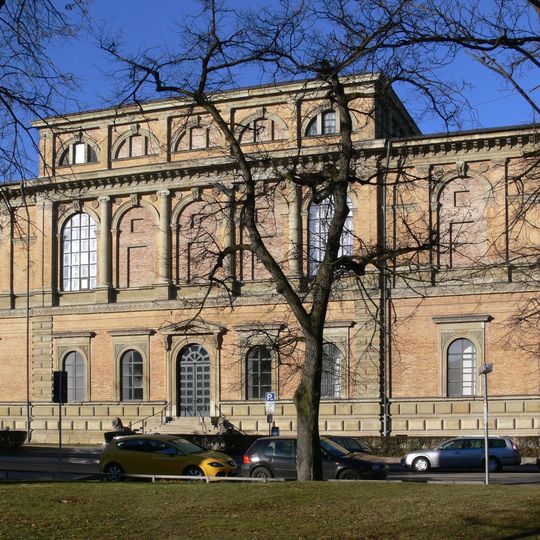
The Alte Pinakothek is a free-standing museum building 150 metres long, 50 wide and 25 high, its one-metre-thick masonry faced with yellow polished brick. A narrow central block is flanked by broader east and west wings; the south facade has a repeating row of large round-arched windows and blind arches in patterned brickwork. The entrance lies on the east side.
King Ludwig I commissioned Leo von Klenze to build the gallery for the Wittelsbach collection from 1826 to 1836. The Neo-Renaissance exterior, 150 metres long and faced with yellow polished brick, departed from the castle-like museums of the period. After bombing in 1944 tore a 45-metre hole in the centre, Hans Döllgast rebuilt it from 1952 to 1957, reopening on 7 June 1957.
The name comes from the Greek pinakotheke, a room where paintings are kept. Since 2008 the upper-floor rooms have been hung with woven, dyed silk from Lyon in alternating green and red, a scheme used at the museum's opening and until the 20th century. The red-and-green alternation continues a tradition of hanging Old Masters seen in galleries such as Florence, Madrid and Vienna.
The entrance is on the east side, not the long south facade, so approach from the east when arriving. The 150-metre building has a narrow central block flanked by broader east and west wings, which helps orientation inside. The upper-floor rooms are reached by stairs, and the pre-war loggia facing the south facade was not rebuilt after the war.
The museum holds the world's largest collection of paintings by Flemish master Peter Paul Rubens, with around 72 works displayed in specially designed spaces. This concentration offers an unmatched view of the artistic range and output of this single painter.
The community of curious travelers
AroundUs brings together thousands of curated places, local tips, and hidden gems, enriched daily by 93,133 contributors worldwide.